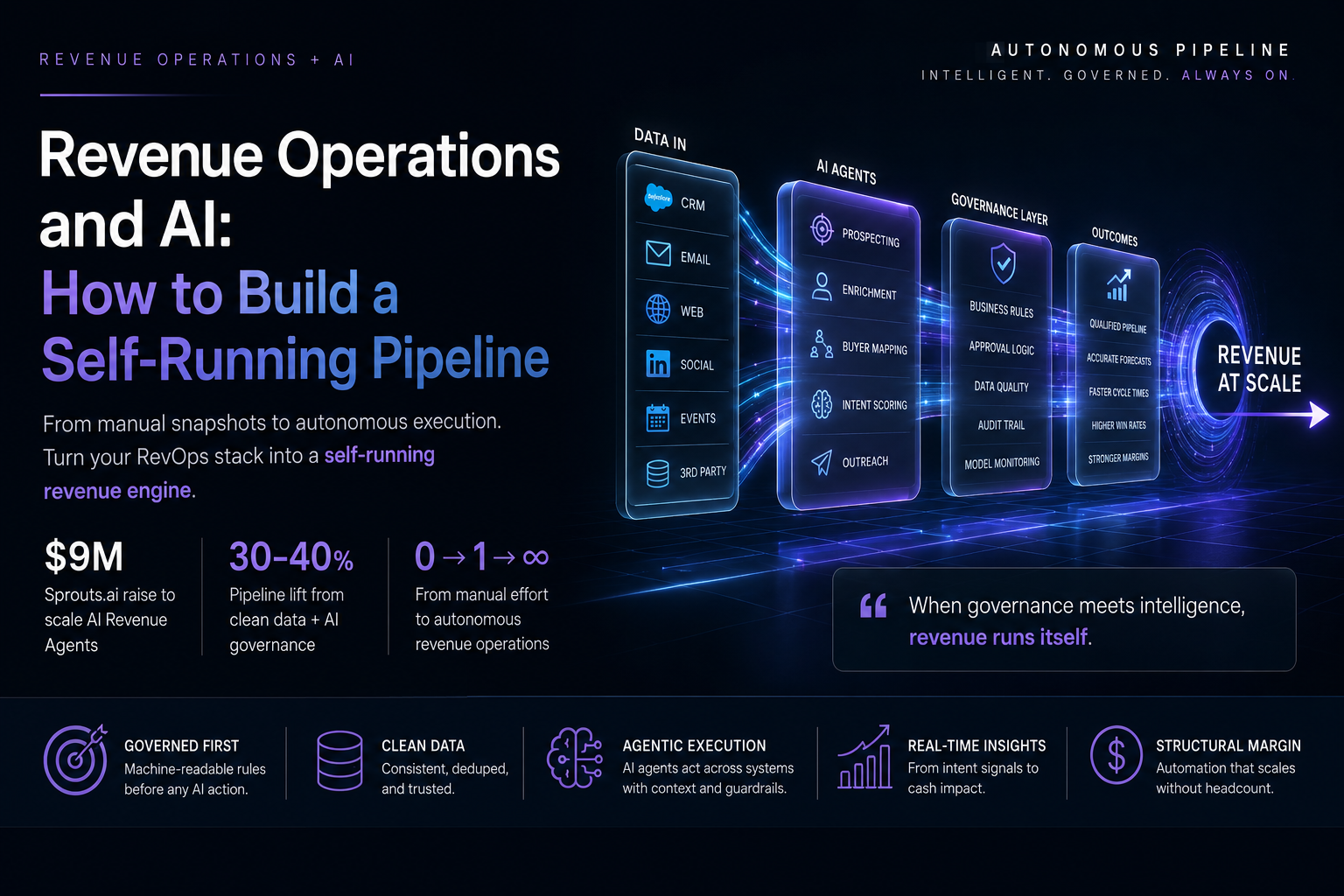
A mid-market B2B company running weekly pipeline snapshots and manual CRM hygiene is already operating at a structural disadvantage. RevOps teams that rely on quarterly data-cleaning projects are now competing against companies where CRM hygiene runs as a continuous automated pipeline — not a calendar event. Sprouts.ai just closed a $9M raise to expand AI Revenue Agents that handle prospecting, contact enrichment, buyer mapping, and multi-channel outreach autonomously. The gap between those two operating models is compounding every quarter.
What's actually shifting is the architecture underneath the go-to-market function. Headless AI is decoupling revenue logic from any single platform, allowing agents to execute across Salesforce, Microsoft Dynamics, and LLM layers like Claude simultaneously. Seamless.ai has moved to open API access on every plan specifically because AI agents — not humans — are now the primary consumers of prospecting data. The companies not rebuilding their RevOps stack around agentic execution aren't just leaving efficiency on the table; they're building technical debt into their growth motion.
The first tactical move is to instrument your pipeline with machine-readable governance before you deploy any agent. DealHub's RevOps framework makes this explicit: no AI agent should execute a pricing decision or approval routing until the business rules governing those decisions exist in a structured, machine-owned layer. Start inside your existing CRM — AWS's SMB guidance confirms this reduces adoption friction and prevents the common failure mode of building a parallel system your reps ignore. Map your stage-exit criteria, ICP definitions, and routing logic into structured fields first, then layer intent scoring and conversation intelligence outputs on top.
The trap most founders walk into is deploying AI tools before their data model can support them. Running AI intent scoring on a CRM with inconsistent lead source tagging or duplicate accounts produces confident-sounding garbage — and worse, it erodes leadership trust in the entire system. Weflow's GTM AI Playbook recommends requiring rep approval before any AI write-back in early stages, and publishing model variance and outcome reports so leadership can verify the system before extending its autonomy. The cost of skipping this step isn't a failed pilot — it's a poisoned dataset that undermines every downstream automation you build on top of it.
When the governance layer is solid and the agents are calibrated, what you've actually built is a revenue system that runs without constant human intervention — the operational definition of a high-margin business. Professional services firms that have automated quote-to-cash, time capture, and project billing have materially reduced revenue leakage from manual steps, according to Sysgenpro's 2026 analysis. Platforms like Sage Intacct 2026 R2 are now embedding AI-powered AP matching and SaaS intelligence directly into financial workflows, closing the loop between pipeline activity and cash position in near real time. That is not a productivity upgrade — it is a structural margin advantage that scales without headcount.
Subscribe to Margin & Machine on LinkedIn for daily briefings on agentic AI and high-margin business architecture at https://www.linkedin.com/build-relation/newsletter-follow?entityUrn=7460380806012760064. If you're ready to implement any of this inside your own revenue stack, book a free strategy call at https://calendly.com/realg-realenterpriseinc/ta-readiness-consultation.
Sources
- Sprouts.ai Raises $9M To Expand AI Revenue Automation Platform
- Seamless Makes API Access Available on Every Plan as AI Agents Reshape B2B Prospecting
- CRM Hacker | Why Headless AI Is Reshaping RevOps, Salesforce, and GTM Architecture
- Own Your Revenue: The RevOps Guide to Governed AI Execution
- Maximize sales success with AI in sales strategies for SMB CEOs
- GTM AI Playbook for RevOps: From Pipeline to Renewals
- Professional Services Workflow Automation to Reduce Revenue Leakage
- Sage Intacct 2026 R2 Updates: AP Automation, AI Governance & Reporting