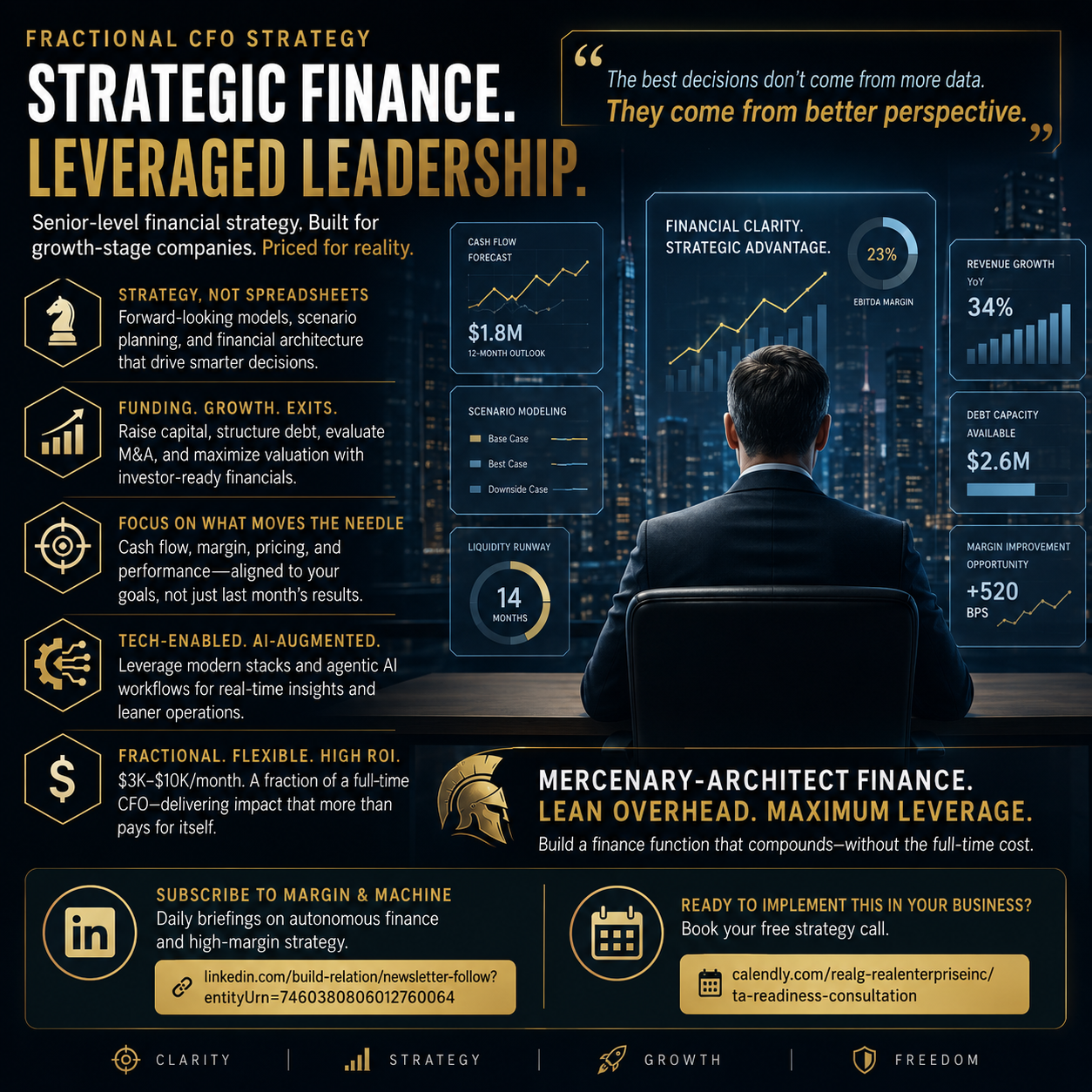
A founder running $3M in revenue with uneven cash flow and no one translating the numbers into decisions is not a finance problem — it's a leadership gap. The SBA guaranteed roughly $45B in 7(a) and 504 loans recently, yet most of those borrowers had no one in the room capable of structuring the deal, modeling the debt service, or timing the draw. A full-time CFO costs $250K–$400K annually in total compensation. That math doesn't work for a company under $10M, and most founders know it.
Fractional CFOs fill exactly that gap — part-time, project-based, or ongoing financial leadership priced for the stage you're actually in. The model has matured significantly in 2026: experienced finance executives now run structured engagements around fundraising, acquisitions, audits, and growth inflection points, then scale back when the pressure normalizes. The cost of not acting isn't just inefficiency — it's strategic blindness. Businesses making margin decisions, hiring decisions, and pricing decisions without forward-looking financial architecture are optimizing for the wrong outcomes.
The first tactical move is to stop confusing your CPA with a CFO. Your CPA files, complies, and reports backward. A fractional CFO looks forward — modeling scenarios, identifying cost-saving opportunities by examining how expenses affect margin, liquidity, and growth simultaneously, and translating financial data into tradeoffs leadership can actually act on. If your revenue has crossed $2M or your cash flow is inconsistent, the cost of that distinction is compounding every quarter. Deploy your accounting stack — QuickBooks, payroll, AP/AR automation — as the data layer, and bring in fractional CFO oversight to interpret and direct it.
The trap most founders fall into is hiring a fractional CFO too late — after the fundraise falls apart, after the audit reveals gaps, after the acquisition LOI expires. The engagement works best when scoped around specific windows: a capital raise, a new market entry, a pricing restructure, or a fiscal year planning cycle. Fractional CFO retainers typically run $3K–$10K per month depending on scope and seniority — a fraction of the full-time alternative, and far cheaper than the decisions made without one. The ROI calculation is simple: one avoided bad hire, one better debt structure, or one margin improvement identified pays for 12 months of engagement.
Zoom out and the strategic picture is clear: the highest-margin businesses are not the ones with the most headcount — they're the ones with the sharpest financial architecture running on the leanest team. A fractional CFO, paired with agentic AI workflows handling bookkeeping, reporting, and financial reconciliation autonomously, creates a finance function that costs less and thinks more. This is the Mercenary-Architect model in practice — ruthless about overhead, precise about leverage, and always building systems that compound without requiring your constant presence.
Subscribe to Margin & Machine on LinkedIn for daily briefings on autonomous finance and high-margin strategy at https://www.linkedin.com/build-relation/newsletter-follow?entityUrn=7460380806012760064. If you're ready to implement any of this in your business, book a free strategy call at https://calendly.com/realg-realenterpriseinc/ta-readiness-consultation.
Sources
- Value Proposition for Fractional CFOs: How to Stand Out and Win Clients
- Fractional CFO Identifies Cost-Saving Opportunities
- Global Expansion for Ecommerce Brands 2026: The Fractional CFO Playbook
- Fractional CFO vs Full-Time CFO: A Hiring Guide
- Fractional CFO: Expert Leadership Without Full-Time Cost
- CFO vs. CPA: When You Need Each One and Why the Difference Matters
- 7 Signs Your Healthcare Practice Needs to Hire a Fractional CFO
- Becoming a Fractional CFO: What to Do and How?