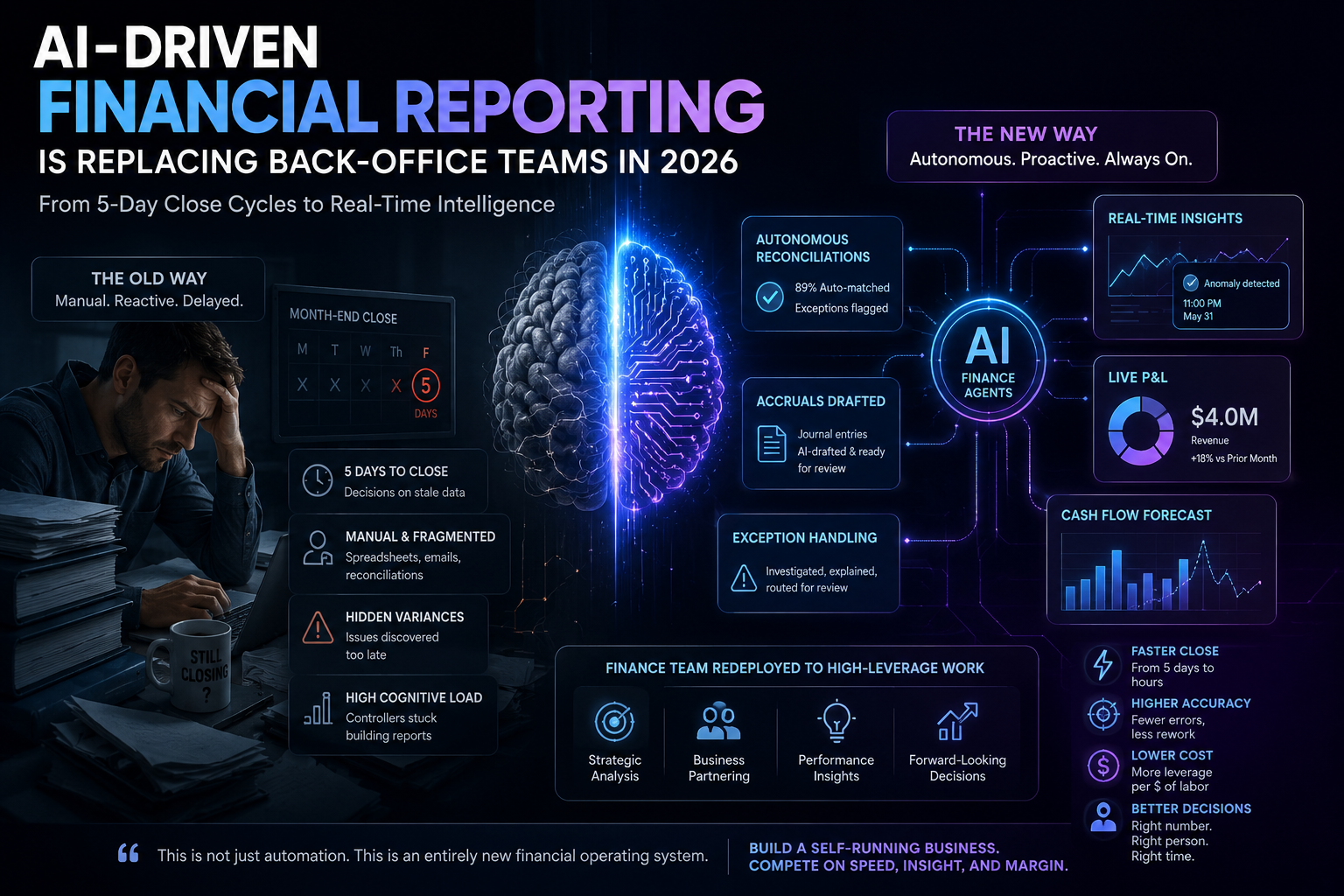
A founder running a $4M services business still waits five days after month-end to see a clean P&L. Meanwhile, their competitor — same revenue, leaner team — gets anomaly alerts at 11 PM on the last day of the month, with accruals already drafted and reconciliations flagged before anyone opens a laptop. That gap is no longer a technology gap. It's a decision gap.
According to KPMG, 93% of US companies will be deploying or scaling AI in their finance functions within the next 18 months. Gartner puts it more precisely: 90% of finance functions will deploy at least one AI-enabled solution by end of 2026, and 15% of day-to-day financial decisions will be made autonomously by 2028. Microsoft's Dynamics 365 Release Wave 1, which rolled out in April 2026, embedded autonomous agents directly into ERP workflows — reconciling accounts and processing invoices without human initiation. Tools like Trintech's agentic finance layer now analyze balance changes across periods, identify material variances, explain likely drivers, and route exceptions for human review. The back office is not being assisted by AI. It is being run by it.
The first move for any CEO is to audit where financial data sits and how long it takes to move. If your books are not syncing in real time to a reporting layer, you are making decisions on stale data — and stale data has a margin cost. BILL's AI-powered AP platform syncs automatically with leading accounting software and handles exception-based processing, meaning your team stops touching routine transactions and starts reviewing only what actually requires judgment. Pair that with QuickBooks' native AI features, which in 2026 have expanded well beyond categorization into cash flow forecasting and anomaly detection, and you have the foundation of an autonomous back-office loop without a six-figure ERP implementation.
The trap most founders fall into is automating the easy parts — invoice intake, receipt matching — and leaving financial reporting manual. That is where the real drag lives. A Controller spending 40% of their week on report assembly is not a people problem; it is a systems architecture problem. Workiva AI now handles narrative drafting, automated data mapping, and anomaly detection across financial, GRC, and sustainability reporting in a single platform. Agentic AP systems like those documented by Dextra Labs can investigate exceptions, understand context, and take cross-workflow action — something rule-based RPA could never do. If your close cycle still takes more than three business days, the bottleneck is almost certainly a workflow that an agent could own entirely.
The companies building durable margin in 2026 are not cutting headcount — they are redeploying it. When agents handle the monitoring, reconciliation, and first-draft reporting, your finance team shifts from data processors to decision support. That is a different organizational design: fewer bodies doing transactional work, more leverage per dollar of labor, and a financial operating system that surfaces the right number to the right person before they ask for it. This is the infrastructure layer of a self-running business — and it compounds. Every workflow you automate today reduces the cognitive load on your leadership team and increases the speed at which you can act on what the numbers are actually telling you.
Subscribe to Margin & Machine on LinkedIn for daily briefings on autonomous systems and financial strategy: https://www.linkedin.com/build-relation/newsletter-follow?entityUrn=7460380806012760064. If you want to map this architecture to your specific business, book a free strategy call here: https://calendly.com/realg-realenterpriseinc/ta-readiness-consultation.
Sources
- BILL | Financial Operations Platform for Businesses & Firms
- 2026 AI Impact Report: How AI Is Impacting Business Revenue and Productivity | QuickBooks
- KPMG Survey: Finance leaders race to scale AI, igniting a critical need for specialized talent and trust
- Finance AI Software Options 2026
- Top Financial Reporting Automation Tools for 2026: What Finance Leaders Actually Need to Know
- Agentic AI for Finance: The Complete Guide for Finance and Accounting Teams
- Agentic AI for Finance Autonomous Accounting Automation | Trintech
- The Ultimate Guide to AI Accounting Optimization in Texas - Netsurit US
- Agentic AI in Dynamics 365: How Autonomous AI Agents Are Transforming ERP in 2026
- Agentic AI for Accounts Payable: Automation Guide 2026