Gartner's latest research landed like a cold bucket of water on the AI hype cycle: companies cutting headcount to fund AI automation are not the ones seeing higher returns. According to a May 2026 Fortune report, workforce reduction rates were nearly identical across both high-ROI and low-ROI automation adopters. The companies winning are not slashing labor — they are redesigning the workflows labor used to run.
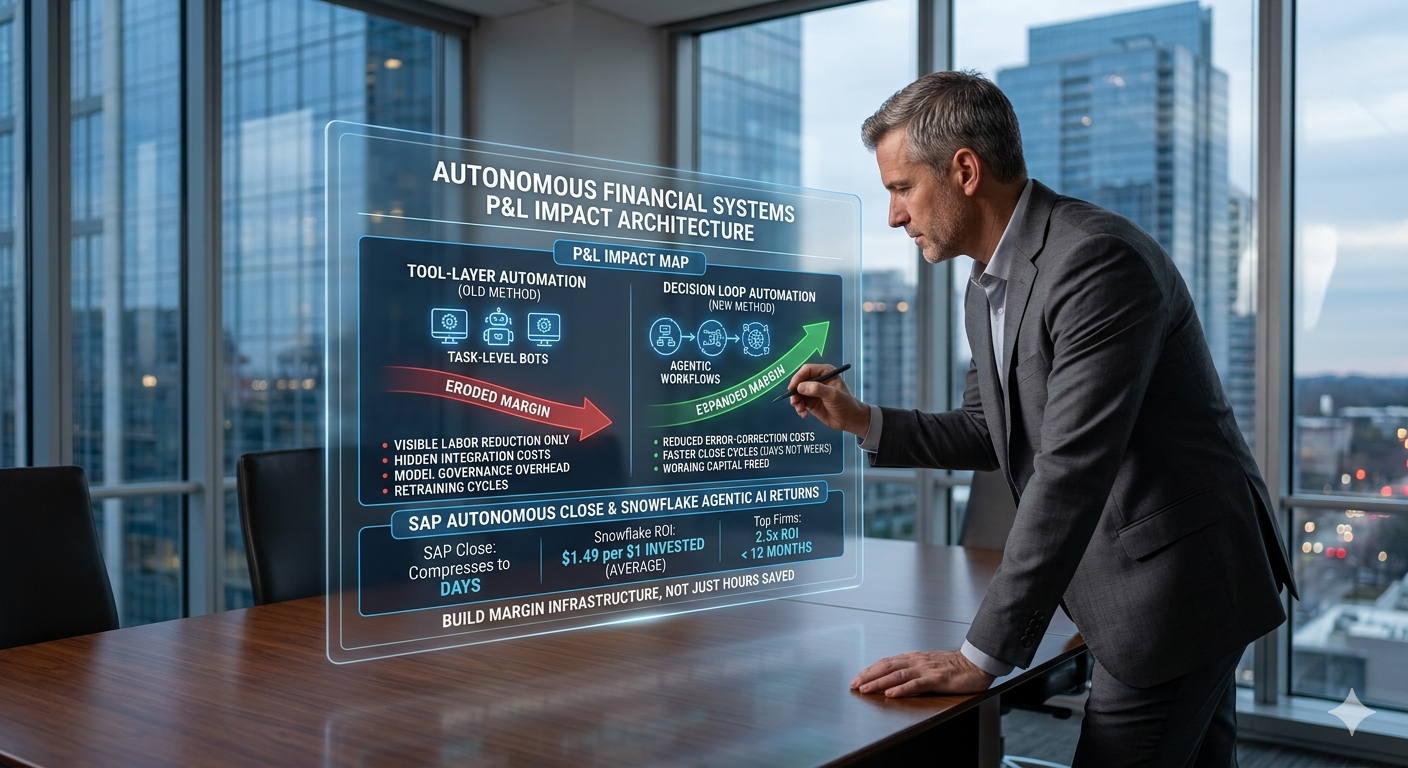
Autonomous financial systems are now operating well past the pilot stage. SAP's Autonomous Close Assistant compiles journal entries, performs reconciliations, and resolves errors — compressing a multi-week financial close into days. Snowflake's 2026 ROI data shows early agentic AI adopters earning $1.49 for every $1 invested, with top-performing financial services firms reporting 2.5x ROI within 12 months. The compounding advantage is not speed — it is the elimination of decision latency across AP, AR, reconciliation, and cash forecasting simultaneously.
The first tactical move is to stop automating tasks and start automating decision loops. A founder who deploys an agentic workflow inside QuickBooks or SAP that flags anomalies, auto-categorizes transactions, and routes exceptions to human judgment only when threshold rules are triggered — that founder is building margin infrastructure, not just saving hours. The P&L impact shows up in three places: reduced error-correction costs, faster close cycles, and working capital freed by tighter cash visibility.
The trap most CFOs fall into is mistaking visible labor reduction for real cost reduction. CXToday's analysis of enterprise automation ROI identifies a consistent blind spot: hidden costs in integration, model governance, shadow AI proliferation, and retraining cycles routinely erode 30–50% of projected savings. Model the full system cost — not just the headcount you think you can remove. The companies with the strongest margins are running AI as infrastructure, with auditability and control baked in from day one, not bolted on after a compliance incident.
Autonomous financial systems are not a finance team upgrade — they are the operating layer of a self-running business. When your close is automated, your anomaly detection is real-time, and your cash forecasting updates continuously from live inputs, you stop reacting to your financials and start steering with them. That is the architectural difference between a founder who is trapped in the business and one who has built a machine that runs without them in every transaction cycle.
Subscribe to Margin & Machine on LinkedIn for daily briefings at the intersection of strategy and autonomous systems: https://www.linkedin.com/build-relation/newsletter-follow?entityUrn=7460380806012760064. If you are ready to implement autonomous financial workflows in your business, book a free strategy call here: https://calendly.com/realg-realenterpriseinc/ta-readiness-consultation.
Sources
- AI isn't paying off in the way companies think. Layoffs driven by automation are failing to generate returns, study finds | Fortune
- AI Automation ROI: The Hidden Costs Enterprises Miss
- 10 Best AI Tools for Finance Teams: Cut SaaS Spend & Automate Procurement | CloudEagle.ai
- What is AI Financial Modeling? | IBM
- AI becomes the banker: The rapid rise of automated testing across finance - QA Financial
- AI-Powered Automation in 2026: Agentic AI, RPA, ROI, and Enterprise Use Cases
- The ROI of Gen AI and Agents 2026 | Snowflake
- Digital Transformation in Financial Services: Complete 2025-2026 Guide | Vantage Point
- SAP Unveils Autonomous AI Strategy to Reduce AI Complexity