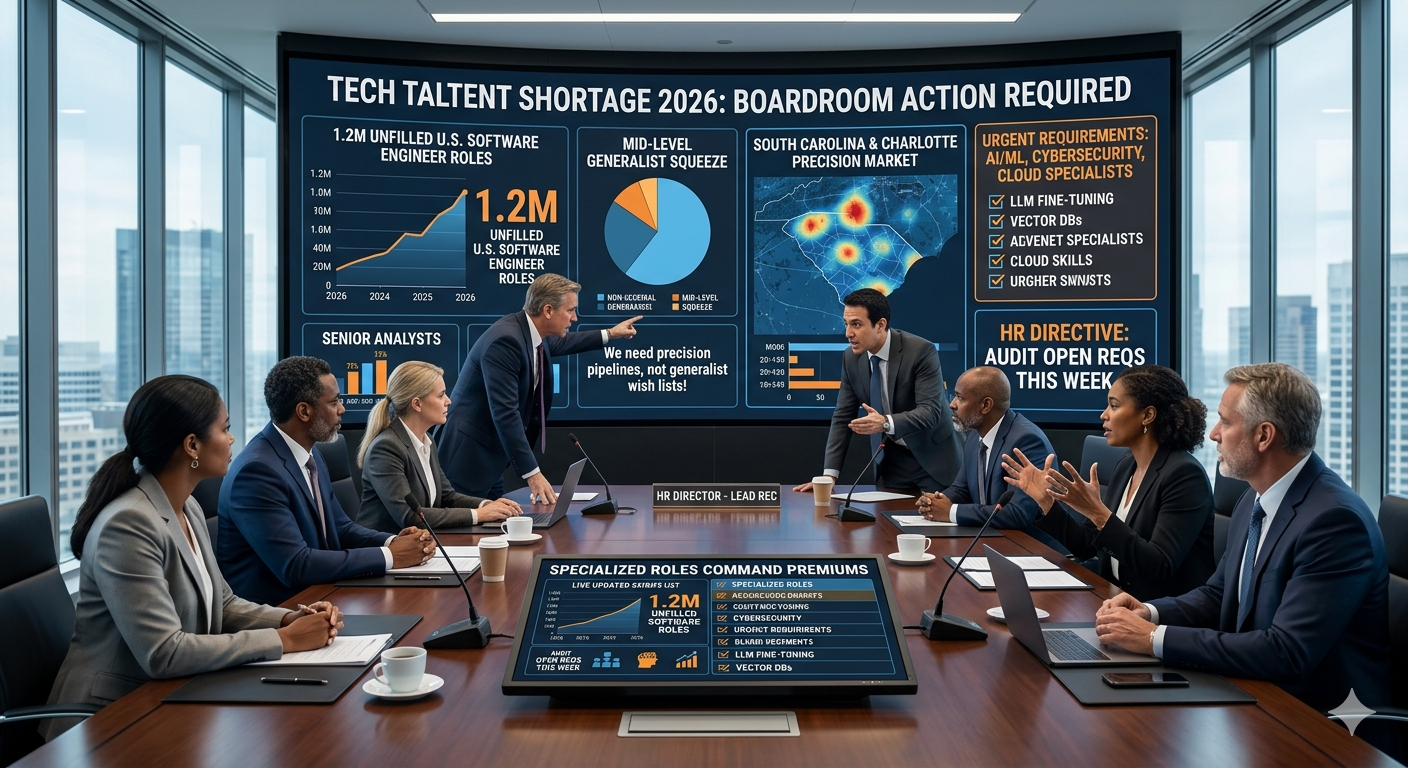
The U.S. software engineer shortage is approaching 1.2 million unfilled roles in 2026, according to Bureau of Labor Statistics projections. At the same time, tech job postings are up 15% since mid-2025, and AI/ML, cybersecurity, and cloud roles are driving the sharpest demand. The market is not uniform — mid-level generalist engineers face the steepest squeeze, while specialists command premium attention. Companies are hiring and cutting simultaneously, which creates real noise for HR teams trying to read the market.
For companies hiring in South Carolina and Charlotte, this bifurcated market requires precision. A broad job description that worked three years ago will not attract the right candidates today. Hiring managers now specify requirements like large language model fine-tuning experience, vector database familiarity, and cloud GPU infrastructure track records. If your job post reads like a generalist wish list, you are competing for a shrinking pool while the specialists you actually need scroll past.
Top-performing hiring organizations have stopped waiting for the perfect passive candidate and started building talent pipelines before roles open. AI fluency is now table stakes — 80% of engineers will need to upskill by 2027, and leading employers are factoring that into both their hiring criteria and their onboarding investment. Companies that define exactly which skills are required versus trainable are closing searches faster and retaining hires longer. Eighty percent of technology leaders in a recent survey cited talent shortages as a major operational challenge — the ones navigating it best treat recruiting as a continuous process, not a reactive one.
HR directors should audit every open tech requisition this week against one question: is this role written for a candidate who exists, or a candidate you wish existed? Strip the description down to the three to five non-negotiable technical requirements. Then identify which skills you are willing to train on. Partnering with a specialized recruiter who works the local South Carolina and Charlotte market daily gives you faster access to candidates who are not on job boards yet. Speed of process remains one of the top reasons qualified engineers accept competing offers — tighten your interview loop to under two weeks.
Watch the mid-level engineering segment closely through Q3 2026. Job postings for Software Engineer roles dropped 39% month-over-month in April 2026, signaling that companies are recalibrating headcount at that band. Whether that correction is temporary or structural will become clearer by Q3. Organizations that use this window to build relationships with displaced mid-level talent now will be best positioned when hiring demand normalizes.
Sources
- Software Developers and Engineers Shortage in the US
- The Future of Software Engineering Jobs in 2026: What Hiring Managers Need to Know
- The AI/ML Talent Shortage: Strategies for Attracting and Retaining Top Engineers in 2026
- Tech Hiring Is Back in 2026 — But Salaries...
- 80% of technology leaders cite talent shortages as a major challenge
- Tech Job Market Trends Monthly | April 2026
- The Developer Job Market Just Changed — Here Is What the Data Says