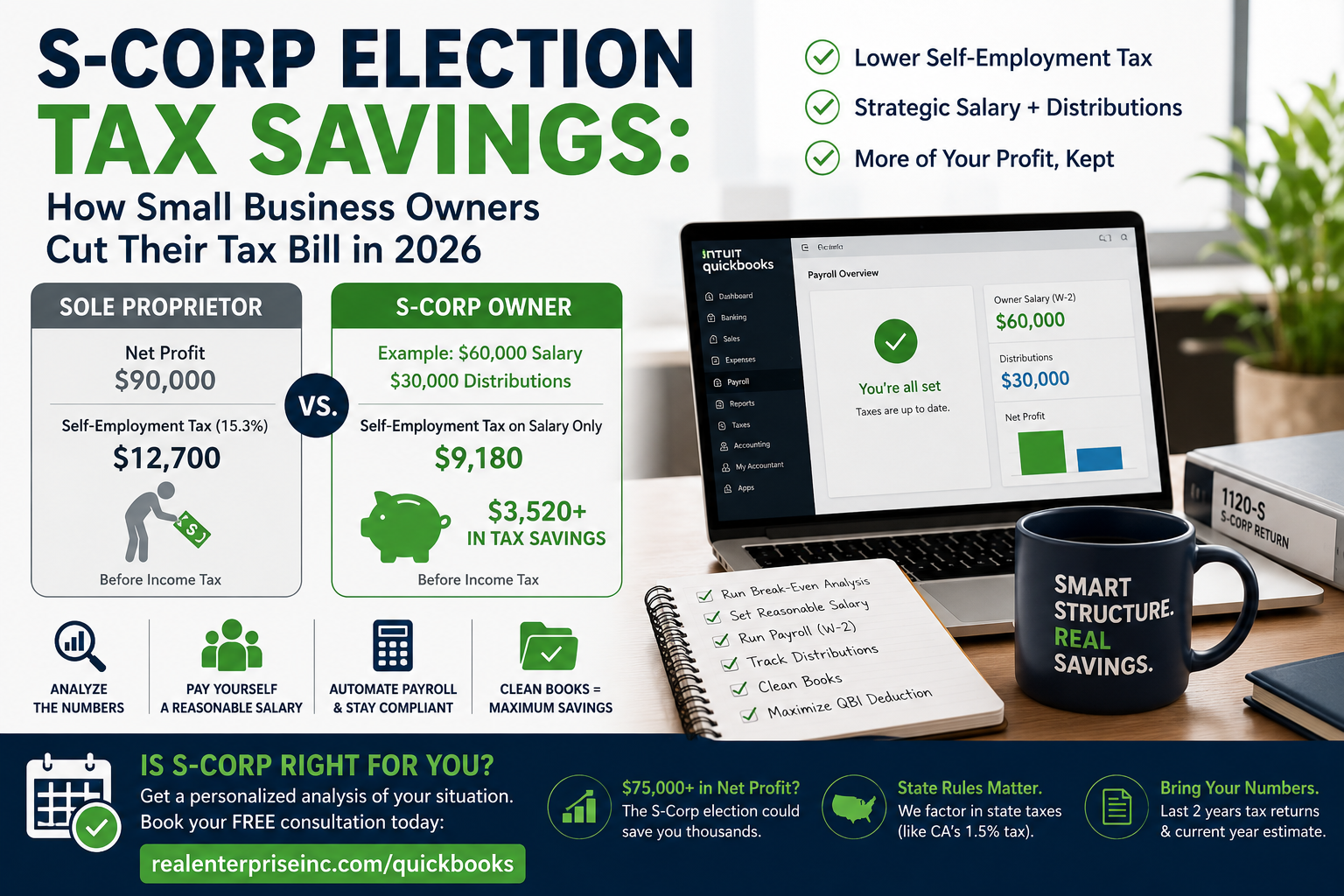
A freelancer netting $90,000 a year as a sole proprietor hands the IRS roughly $12,700 in self-employment tax alone — before a single dollar of income tax. That 15.3% hit on every dollar of net profit is one of the most painful and least-discussed tax burdens for self-employed people. Electing S-Corp status can legally eliminate a significant portion of that bill. But the strategy only works when it's set up correctly.
Here's what most business owners get wrong: they think electing S-Corp *automatically* creates savings. It doesn't. The real lever is how you split your income between a W-2 salary and owner distributions. As an S-Corp owner-employee, only your salary is subject to payroll taxes — your distributions are not. If your salary is set too high, the savings disappear. If it's set unreasonably low, the IRS will reclassify your distributions as wages and assess back taxes plus penalties. The IRS expects a "reasonable compensation" standard, and that determination depends on your industry, role, and market data.
The first practical step is running a break-even analysis before you elect. S-Corp compliance isn't free — expect to pay $3,500 to $5,000 per year in additional accounting, payroll administration, and tax preparation costs. At net income below $50,000, those compliance costs typically erase any self-employment tax savings. Most CPAs use the $60,000–$80,000 net income threshold as the floor where the math starts making sense. If you're clearing $75,000 to $100,000 in net profit, the election often yields $1,000 to $3,000 in *net* annual savings after expenses — and it grows from there.
The second step is setting up payroll correctly from day one. As an S-Corp owner, you must run yourself through payroll and issue a W-2 — there's no workaround. Use QuickBooks Payroll to automate federal and state withholding, track employer payroll tax deposits, and generate the quarterly Form 941 filings the IRS requires. QuickBooks Online also integrates directly with your chart of accounts so your salary expense and distribution draws are recorded separately, which matters enormously at tax time. Commingling these two income types in your books is one of the fastest ways to trigger compliance problems.
Clean bookkeeping isn't just an administrative detail here — it's the foundation the entire tax strategy rests on. Your CPA needs clear records to substantiate your reasonable salary, calculate your Qualified Business Income (QBI) deduction under Section 199A, and prepare your Form 1120-S accurately. If your books are behind or your payroll is misclassified, you can't take full advantage of the deduction — and QBI alone can shelter up to 20% of qualified business income from federal income tax. Getting your QuickBooks file organized, reconciled monthly, and categorized correctly is what turns a good tax strategy into actual dollar savings.
If you're in the $75,000-and-up range and still filing as a sole proprietor or single-member LLC, it's worth sitting down with someone who can model the actual numbers against your situation — including your state's rules, since states like California add a 1.5% tax on S-Corp net income that changes the calculus. A free consultation at realenterpriseinc.com/quickbooks is a good place to start. Bring your last two years of tax returns and your current year revenue estimate, and you'll walk away knowing whether the election actually makes sense for you.
Sources
- S-Corporation Tax Guide: Salary, QBI, Distributions & More | SDO CPA
- Small Business S Corporation Taxes 2026: How to Save & Stay Compliant | QuickBooks
- S-Corp Tax Calculator: See Your Tax Savings | SDO CPA
- S Corporation Tax Planning Guide (2026) for Business Owners | Madsen and Company
- How to Choose the Right Business Structure for Tax Savings (2026 Guide)
- LLC vs S-Corp Taxes: Savings at Every Income Level | SDO CPA
- What Is An S Corp? Definition, Benefits & 2026 Tax Rules | Swyft Filings Blog