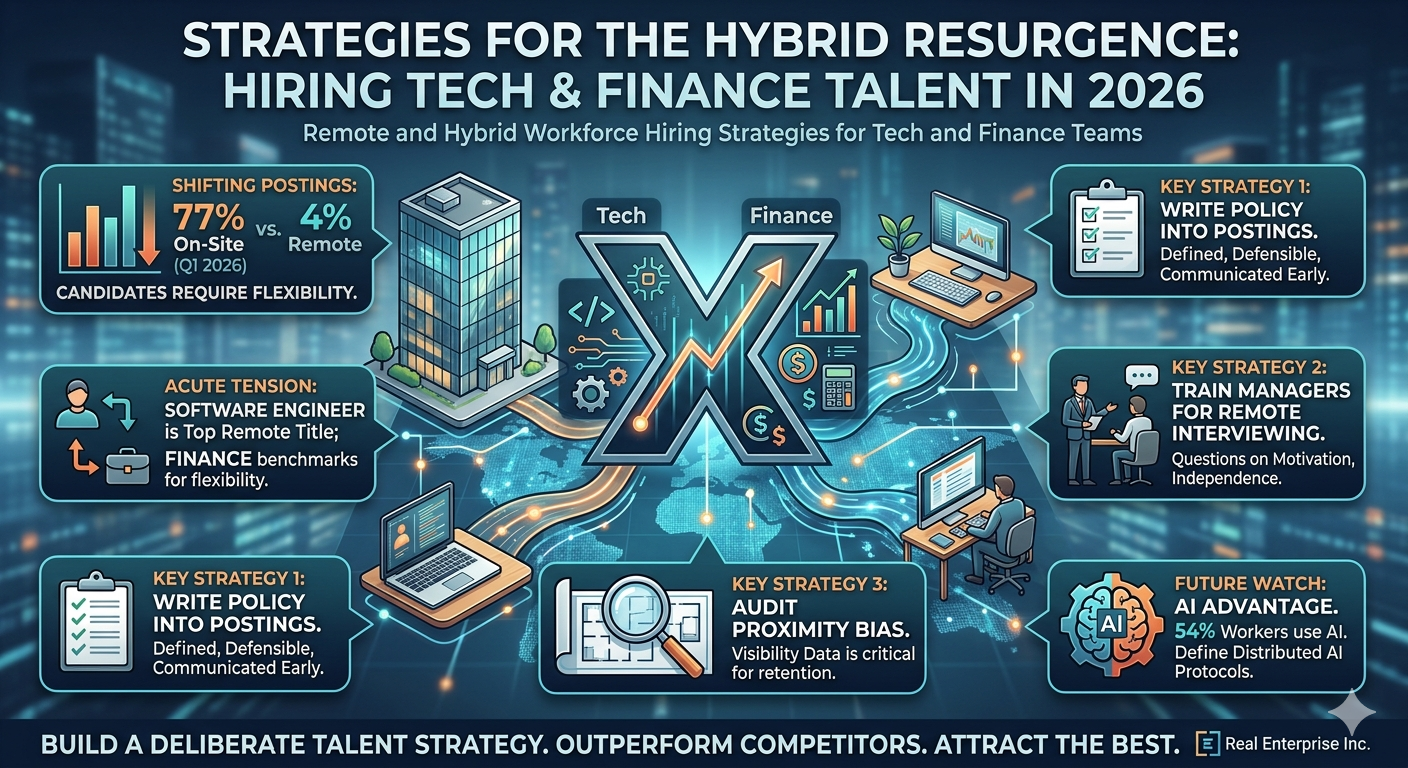
The remote work pendulum has swung hard toward on-site. In Q1 2026, 77% of new job postings are fully on-site, 19% are hybrid, and only 4% are fully remote. That shift is real — but it hasn't killed candidate expectations. Flexible work arrangements are now the baseline expectation for most job seekers, not a perk. Companies that ignore that gap are going to lose candidates to competitors who don't.
For tech and finance hiring specifically, this tension is acute. Software engineer remains the top remote-hired title on major platforms, and finance and accounting professionals increasingly benchmark offers against flexibility. If your open roles require five days in a Charlotte or Columbia office with no flexibility, your candidate pool shrinks significantly. That doesn't mean you have to go fully remote — it means your hybrid policy needs to be defined, defensible, and communicated early in the recruiting process.
Top companies are addressing this with structure, not guesswork. They're building role-based hybrid models — where flexibility is tied to job function, not personal preference — and evaluating performance on output metrics rather than presence. They're also investing in onboarding: hybrid new hires need digital access, documentation, and deliberate check-in schedules before day one, because the informal learning that happens naturally in an office doesn't occur on its own in a distributed setup. Eighty-seven percent of employees say having the right technology is critical to succeeding in a hybrid environment.
HR directors hiring in 2026 need to do three things now. First, write your hybrid policy into the job posting — candidates will ask, and ambiguity costs you offer acceptances. Second, train your hiring managers to interview for remote competency. Questions like "How do you stay motivated when working independently?" or "Walk me through a time you solved a problem without in-person support?" surface candidates who will actually succeed in a distributed environment. Third, audit your promotion and visibility data by work arrangement. Proximity bias — where in-office employees get more face time with leadership and advance faster — is a retention risk that quietly drives hybrid talent out the door.
Watch the AI variable closely over the next two quarters. Fifty-four percent of workers are already using AI tools on the job, and that number is higher in tech and finance. As AI reshapes distributed workflows, the companies that define clear protocols for remote AI usage will have a structural advantage in both hiring and retention. The hybrid model isn't going away — but it's getting more complex, and the firms with deliberate talent strategies will outperform those still treating it as a temporary accommodation.
Sources
- Remote Work Statistics and Trends for 2026 — Robert Half
- Remote Work Trends 2026: 40+ Statistics Shaping the Future of Work — Gable
- Remote Work in 2026: 50+ Key Statistics & Trends — WorkTime
- Remote Work Statistics for 2026: Adoption, Pay, Trends — Second Talent
- Improving Candidate Experience in Hybrid Hiring — Rent a Recruiter
- 5 Recruitment Strategies for Hybrid Teams — Rent a Recruiter
- Hybrid Work — Recruitment & Hiring Glossary 2026 — Avua
- Hybrid Workplace: Models, Onboarding, and Guide — FirstHR