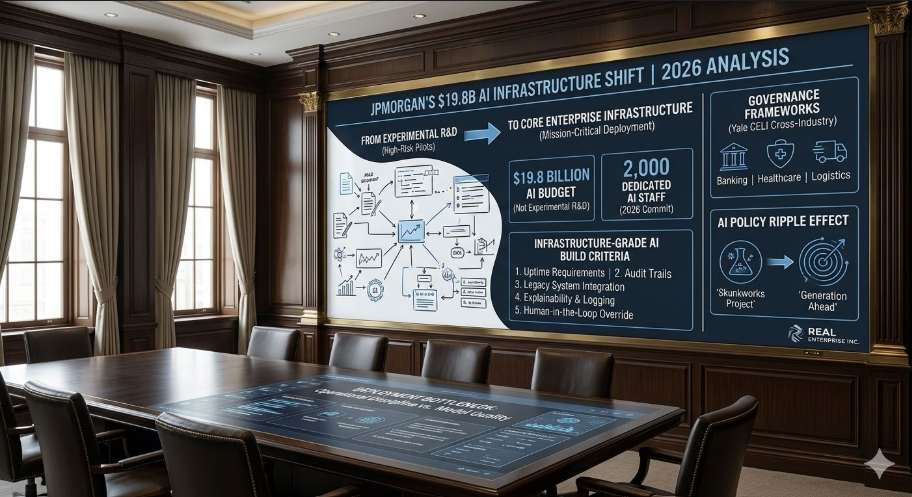
JPMorgan Chase has formally reclassified its AI investments from experimental R&D into core infrastructure, committing a $19.8 billion technology budget and 2,000 dedicated AI staff for 2026. This is not a pilot program. This is a bank treating AI the same way it treats its trading systems and payment rails — as mission-critical. The reclassification alone is a policy signal that ripples well beyond financial services.
The distinction between "experimental" and "infrastructure" matters technically. Infrastructure-grade AI means uptime requirements, audit trails, integration with legacy systems, and procurement standards that experimental budgets never demand. It also means the tooling around AI — orchestration, monitoring, governance — becomes as important as the models themselves. Simultaneously, Stanford HAI's 2026 AI Index confirms that the field is hitting breakthrough capabilities while raising urgent questions about environmental costs, transparency, and accountability.
Any enterprise that still treats AI as a skunkworks project is now operating a generation behind the largest institutions in the world. Regulated industries — banking, healthcare, insurance, logistics — face the sharpest pressure. Yale's Chief Executive Leadership Institute published a cross-industry governance framework this week covering exactly these sectors, identifying eight variables that determine whether agentic AI deployment is safe, auditable, and reversible. Governance is no longer a compliance checkbox; it is a competitive capability.
For teams building AI-powered workflows, the infrastructure mindset changes the build criteria entirely. Automation that cannot be explained, reversed, or monitored will not survive procurement reviews at enterprise clients. The workflows worth building now are the ones that include logging, human-in-the-loop override points, and clear accountability chains — not just the ones that complete tasks fastest. A new AI creativity benchmark from a 100,000-person study shows generative AI now outperforms average humans on certain creative tasks, which expands the surface area of automatable work but also raises the stakes for governance around that output.
Watch for mid-market companies to begin adopting stripped-down versions of JPMorgan's infrastructure frameworks over the next two quarters. OpenAI's GPT-5.5 Instant release and Anthropic's updated Claude Opus model this week both add capability headroom that makes these governance questions more urgent, not less. The bottleneck in enterprise AI is no longer model quality — it is the operational discipline to deploy responsibly at scale.