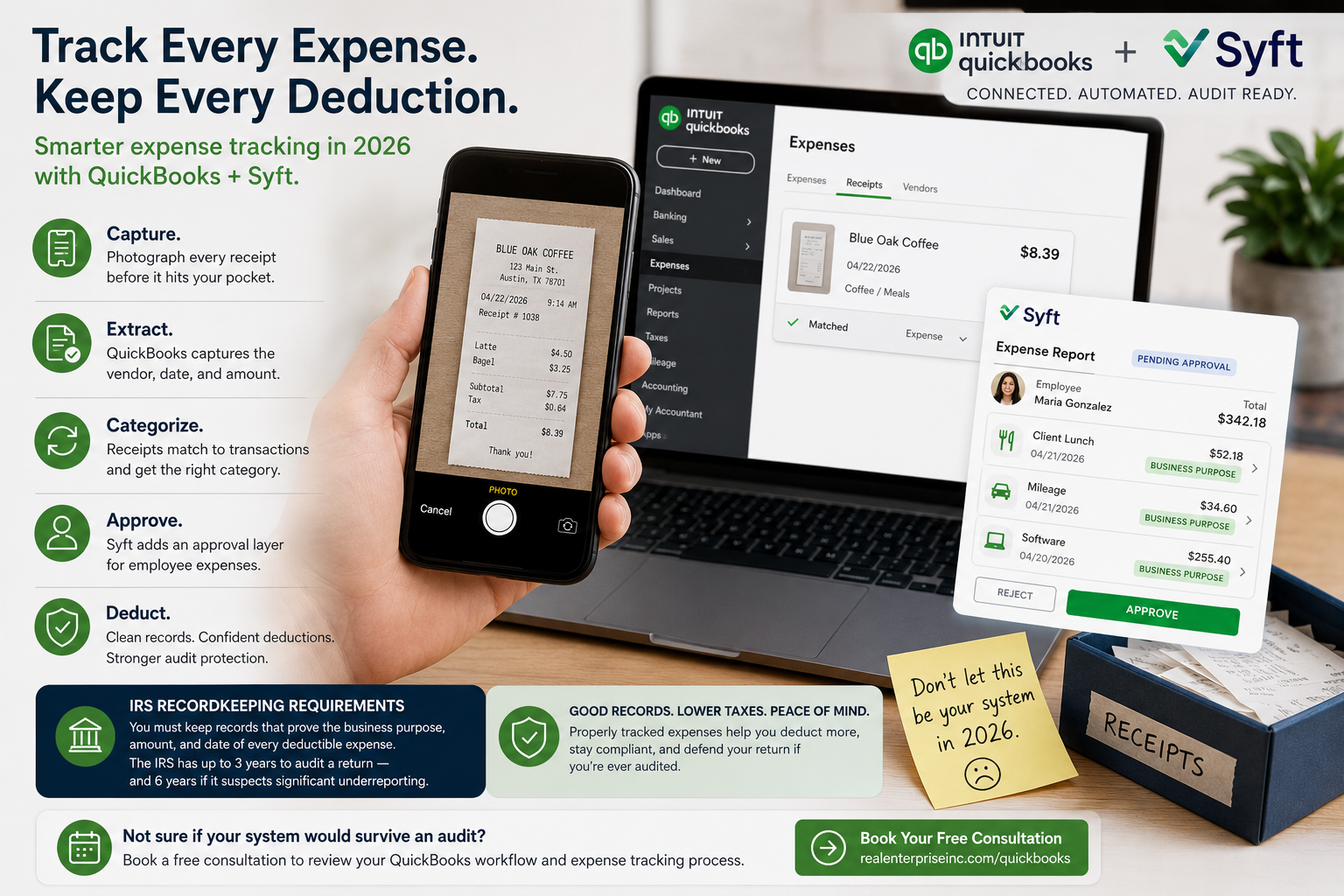
The IRS requires you to keep records that prove the business purpose, amount, and date of every deductible expense. Most small business owners do this with a shoebox — literally. One survey found that nearly 40% of small business owners still manage receipts manually, and that habit quietly costs them at tax time through missed deductions, disorganized records, and the kind of panic that hits in April.
The real problem isn't laziness — it's a broken system. Most owners mix personal and business spending, let receipts pile up for weeks, and then try to reconstruct expenses from memory. The IRS doesn't accept "I'm pretty sure that was a business lunch." Under IRC Section 274, meals and entertainment require documented business purpose. Without it, your deduction gets denied and your effective tax bill goes up.
Start with your QuickBooks Online account. QuickBooks has a built-in receipt capture feature — you can photograph a receipt from your phone and it will extract the vendor, date, and amount, then match it to an existing transaction. Set a rule right now: every business purchase gets photographed before the receipt hits your pocket. Batch this habit with something you already do, like reviewing your phone at the end of each day. This single change eliminates most of the chaos.
If you have employees submitting expenses, add a dedicated tool to your workflow. Expensify and Zoho Expense both integrate with QuickBooks and add an approval layer — so you're not manually reviewing every receipt. For businesses with a backlog of paper receipts, Shoeboxed offers a mail-in scanning service that digitizes and categorizes everything. The goal is a system where every dollar spent has a digital record, a category, and a home before it touches your books.
Clean expense tracking doesn't just make bookkeeping easier — it directly reduces your tax liability. When your expenses are properly categorized and documented, your accountant can confidently deduct home office costs under Section 280A, vehicle mileage under Section 179, and software subscriptions as ordinary business expenses. Sloppy records, on the other hand, make your return harder to defend if you're ever audited. The IRS has up to three years to audit a return — and six if it suspects significant underreporting. Good records are your first line of defense.
If you're not sure whether your current system would survive an audit or whether you're leaving deductions on the table, it's worth talking to someone who can look at your actual setup. You can book a free consultation to walk through your QuickBooks workflow and expense tracking process at [https://www.realenterpriseinc.com/quickbooks](https://www.realenterpriseinc.com/quickbooks). Sometimes one conversation is enough to fix the gaps that cost you the most.
Sources
- Best 12 Expense Tracking Apps for Small Business 2026
- The Best Expense Management Software 2026
- The best receipt scanners for small businesses in 2026 | QuickBooks
- 9 Best Receipt Scanner Apps for Small Business (2026)
- Rho | Best Business Receipt Scanner Apps 2026
- How To Organize Business Receipts With Automation