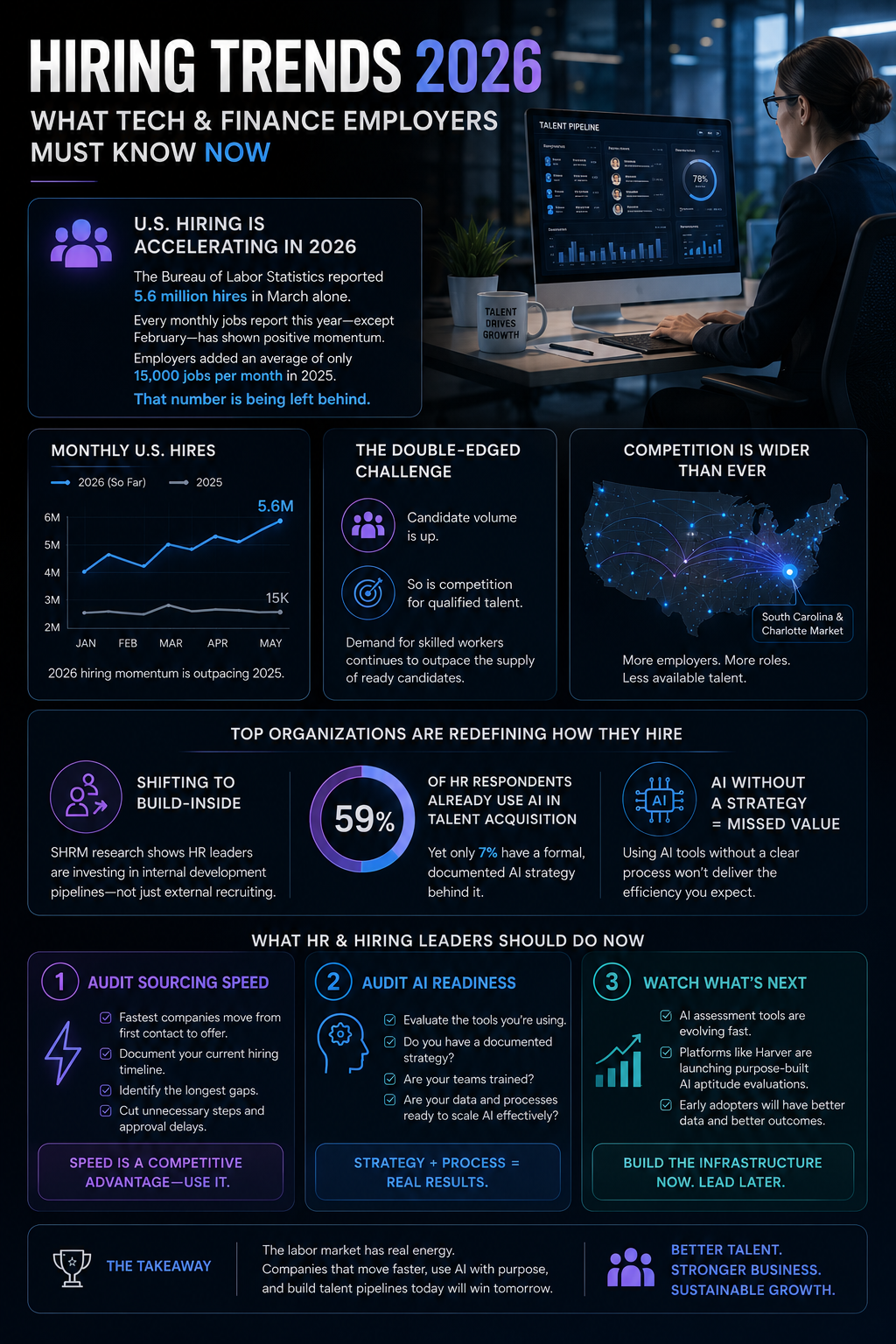
U.S. hiring is running stronger in 2026 than it was in 2025. The Bureau of Labor Statistics reported 5.6 million hires in March alone, and every monthly jobs report this year — except February — has shown positive momentum. Employers added an average of only 15,000 jobs per month in 2025. That number is being left behind. The labor market has real energy right now, and companies that aren't actively recruiting are already falling behind.
For tech and finance hiring specifically, that momentum creates a double-edged problem. Candidate volume is up, but so is competition for qualified talent. HR faces persistent hiring challenges in 2026 because demand for skilled workers continues to outpace supply of ready candidates. If your company is hiring engineers, developers, accountants, or financial analysts in South Carolina or the Charlotte market, you are competing against a wider pool of employers than you were 18 months ago.
Top organizations are responding by rethinking the build-versus-buy equation. SHRM research shows HR leaders are shifting focus toward internal development pipelines — not just external recruiting. At the same time, 59% of HR respondents report already using AI in talent acquisition, yet only 7% have a formal, documented AI strategy behind it. That gap is significant. Companies using AI tools without a clear process aren't gaining the efficiency they expect.
Hiring managers and HR directors should audit two things this week: their sourcing speed and their AI readiness. The firms winning on talent right now move from first contact to offer faster than the market average. If your process has unnecessary steps or approval delays, candidates are accepting other offers before you close. Document your current hiring timeline, identify the longest gaps, and cut them. Speed is a competitive advantage that costs nothing to improve.
Watch how AI assessment tools evolve over the next two quarters. Platforms like Harver are launching purpose-built AI aptitude evaluations specifically designed for talent acquisition decisions. As these tools mature and adoption spreads, companies that integrate structured AI readiness screening early will have cleaner data and better hiring outcomes. The employers who build that infrastructure now won't have to scramble when it becomes standard.
Sources
- Is the labor market finally cracking? What the April jobs report reveals
- Job Openings and Labor Turnover Summary - 2026 M03 Results
- Rethinking Talent: Why HR Must Build, Not Just Buy
- Outdated Methods Are Undermining Hiring Decisions, Says McLean & Company
- Harver Launches AI PREVAIL™: The First Purpose-Built AI Readiness Assessment for Talent Acquisition and Employee Development