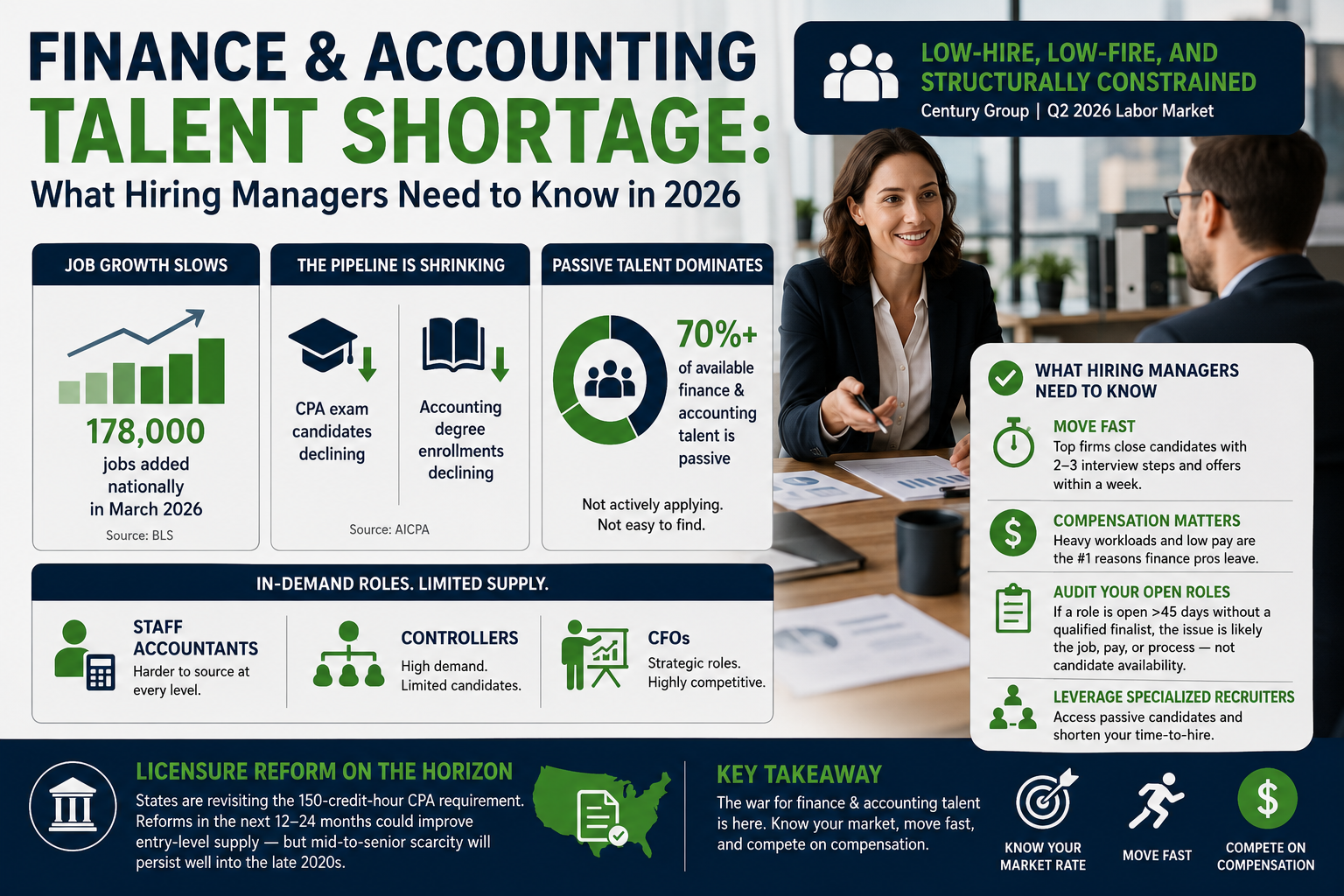
The Q2 2026 labor market for accounting and finance professionals is running in a mode Century Group calls "low-hire, low-fire, and structurally constrained." A modest 178,000 jobs were added nationally in March, but movement in finance and accounting remains sluggish. Beneath that stillness sits a structural problem: CPA exam candidates and accounting degree enrollments are both declining, according to the AICPA. This isn't a temporary dip — it's a pipeline that has been narrowing for years.
For companies hiring in South Carolina and Charlotte, the practical impact is a smaller active candidate pool at every level. Staff accountants, controllers, and CFOs are all harder to source than the national unemployment rate suggests. Passive candidates — people already employed and not actively searching — now make up the majority of available talent in this space. That means traditional job postings alone will not fill most finance roles.
Top-performing companies are adjusting their compensation benchmarks and moving faster through hiring stages. Heavy workloads and insufficient pay are consistently cited as the top reasons accounting professionals leave or disengage from the field entirely. Firms that have shortened their interview processes to two or three steps — and presented offers within a week of final interviews — are closing candidates that slower competitors are losing. Speed and compensation clarity are now competitive advantages, not nice-to-haves.
HR directors and hiring managers should audit their open finance requisitions right now. If any role has been open longer than 45 days without a qualified finalist, the job description, compensation range, or process is likely the bottleneck — not candidate availability. Engaging a specialized finance and accounting recruiter with an active passive-candidate network will cut that timeline significantly. Know your market rate before you post, not after you lose a candidate.
Watch for state-level CPA licensure reform efforts to reshape the candidate pool over the next 12 to 24 months. Several states are revisiting the 150-credit-hour requirement that has long been a barrier to CPA candidates. If those reforms pass broadly, entry-level supply could improve — but mid-to-senior level scarcity will persist well into the late 2020s.
Sources
- Q2 2026 Employment Report for Accounting & HR Professionals | Century Group
- The Accounting Talent Shortage. Here's Why It Exists and What To Do About It. | Sherpa LLC
- Research Sheds New Light On Factors Impacting The Shortage Of Accountants | Forbes
- How States are Rethinking CPA Licensure to Address the Accountant Shortage | Controllers Council
- The accounting talent crisis is already shifting, but most firms just haven't noticed | Accounting Today