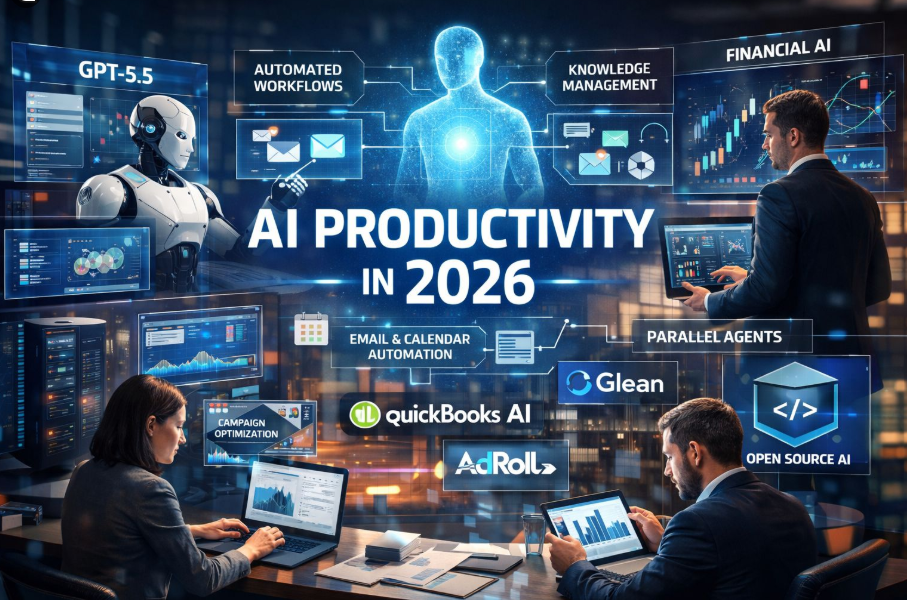
The 2026 AI productivity tool landscape has matured fast. Ranking sites and enterprise reviewers are now organizing top tools by business function — Marketing, Sales, Finance, HR, and Operations — rather than treating AI as a single category. That shift signals something important: businesses are moving past experimentation and into structured deployment. The question is no longer "should we use AI?" It's "which tool owns which job?"
What's driving this reorganization is the rise of task-specific AI agents. These are not general chatbots — they are purpose-built systems trained or fine-tuned to handle discrete workflows: drafting outbound sales sequences, transcribing and summarizing meetings, flagging budget anomalies, or screening job applicants. Platforms like Asana are integrating AI coordination layers that manage work between humans and AI systems simultaneously. Meanwhile, tools like Perplexity are expanding into agentic browsing, letting users delegate research tasks rather than just query for answers.
Operations leaders and department heads should pay close attention here. The ROI argument for AI tools has shifted from soft productivity gains to measurable workflow compression — fewer handoffs, faster turnaround, lower headcount requirements for repetitive tasks. Companies still evaluating tools at the pilot stage are falling behind peers who have already embedded AI into daily team processes. The gap between early adopters and late movers is widening in 2026, and it is showing up in output speed and margin.
This functional segmentation of AI tools maps directly to where automation delivers the most leverage. When a sales team uses one AI system for prospecting and another for CRM updates, those tools need to talk to each other — and that integration layer is where most companies lose time and money. Building clean workflows means choosing tools that connect well, not just tools that perform well individually. Automation consulting exists precisely to solve that coordination problem before it becomes a cost center.
Watch for consolidation. The number of AI tools on ranked lists is high right now — 19 to 25 tools per category is not sustainable for most mid-market buyers. Vendors will bundle, acquire, or get replaced by platforms that cover multiple functions natively. Businesses that locked into too many single-point solutions in 2024 and 2025 are already feeling the integration debt. The next 12 months will reward teams that build lean, connected stacks over those chasing the newest tool release.
Sources
- Best AI Productivity Tools for 2026: 19 Tools Ranked by Business Function
- 9 Best AI Productivity Tools (2026): Ranked & Reviewed
- Top AI Tools Every Business Needs in 2026
- Best AI Productivity Apps for Business Teams in 2026
- Top AI Tools for Mature Businesses to Boost Workflow Efficiency in 2026
- Best Artificial Intelligence Software 2026