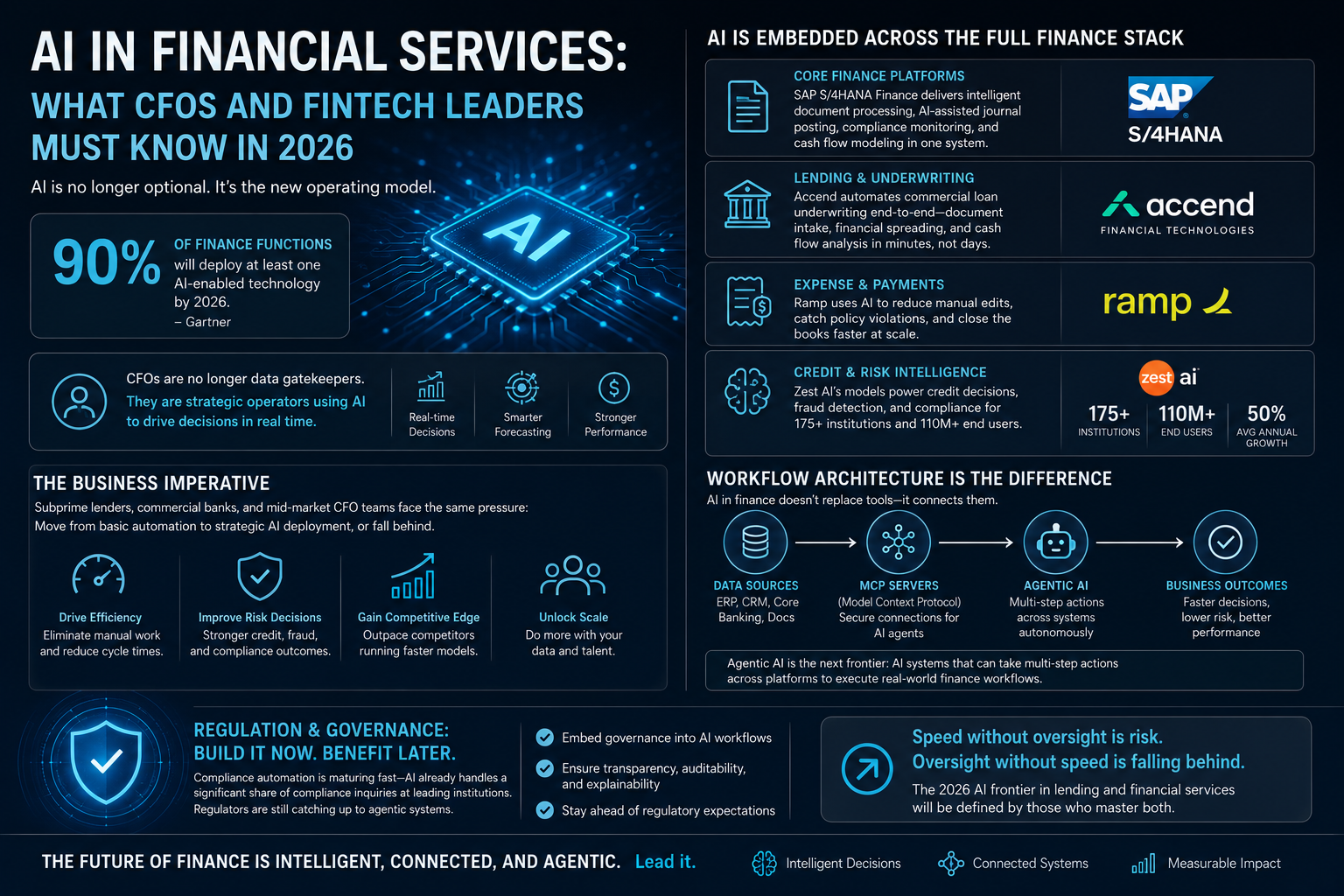
Gartner projects that 90 percent of finance functions will deploy at least one AI-enabled technology by 2026. That threshold is effectively here. The question has shifted from "should we use AI?" to "how do we lead with it?" CFOs are no longer data gatekeepers — they are now expected to be strategic operators using AI to drive decisions in real time.
Technically, this means AI is embedded across the full finance stack. Platforms like SAP S/4HANA Finance now handle intelligent document processing, AI-assisted journal posting, compliance monitoring, and cash flow modeling inside a single system. Startups like Accend are automating commercial loan underwriting end-to-end — document intake, financial spreading, and cash flow analysis — tasks that previously required days of analyst time. At the transaction layer, tools like Ramp are using AI to reduce manual edits on expense management at scale.
The business implications are broad. Subprime lenders, commercial banks, and mid-market CFO teams are all facing the same pressure: move from basic automation to strategic AI deployment, or fall behind competitors who already have. Zest AI has demonstrated this concretely — over 175 financial institution clients, 110 million end users, and 50 percent average annual growth. Companies that delay are not just missing efficiency gains; they are ceding credit decisions, fraud detection, and compliance accuracy to competitors running faster models.
This is where workflow architecture matters. AI in finance does not work by replacing one tool — it works by connecting systems so that data flows without manual handoffs. Agentic AI, a theme at the 2026 Agentic AI and Automation in Finance Summit in Frankfurt, refers to AI systems that can take multi-step actions autonomously across platforms. MCP (Model Context Protocol) servers are emerging as the infrastructure layer that lets AI agents securely connect to banking and fintech systems in production environments. Getting this architecture right is the difference between a pilot and a scalable operation.
Watch the regulatory layer closely over the next 12 months. Compliance automation is maturing fast — AI is already handling a significant share of compliance inquiries at leading institutions — but regulators are still catching up to agentic systems. Firms that build governance into their AI workflows now, rather than retrofitting it later, will have a durable advantage. The 2026 AI frontier in subprime finance and broader lending markets will be defined by who can balance speed with oversight.
Sources
- Financial Services Compliance Automation: What Works
- Finance AI Software Options 2026
- Embracing the 2026 AI Frontier in Subprime Finance | Wolters Kluwer
- Using AI to Reshape the Finance Function in 2026 - FutureCFO
- Agentic AI & Automation in Finance Summit, Frankfurt | Financial IT
- Finance Startups Funded by Y Combinator (YC) 2026 | Y Combinator
- Banking Fintech MCP Servers for AI Agents | Vinkius
- 10 Key Uses of AI in Fintech For Secure and Compliant Solutions
- Ramp – Spend Management, Corporate Cards & Accounts Payable