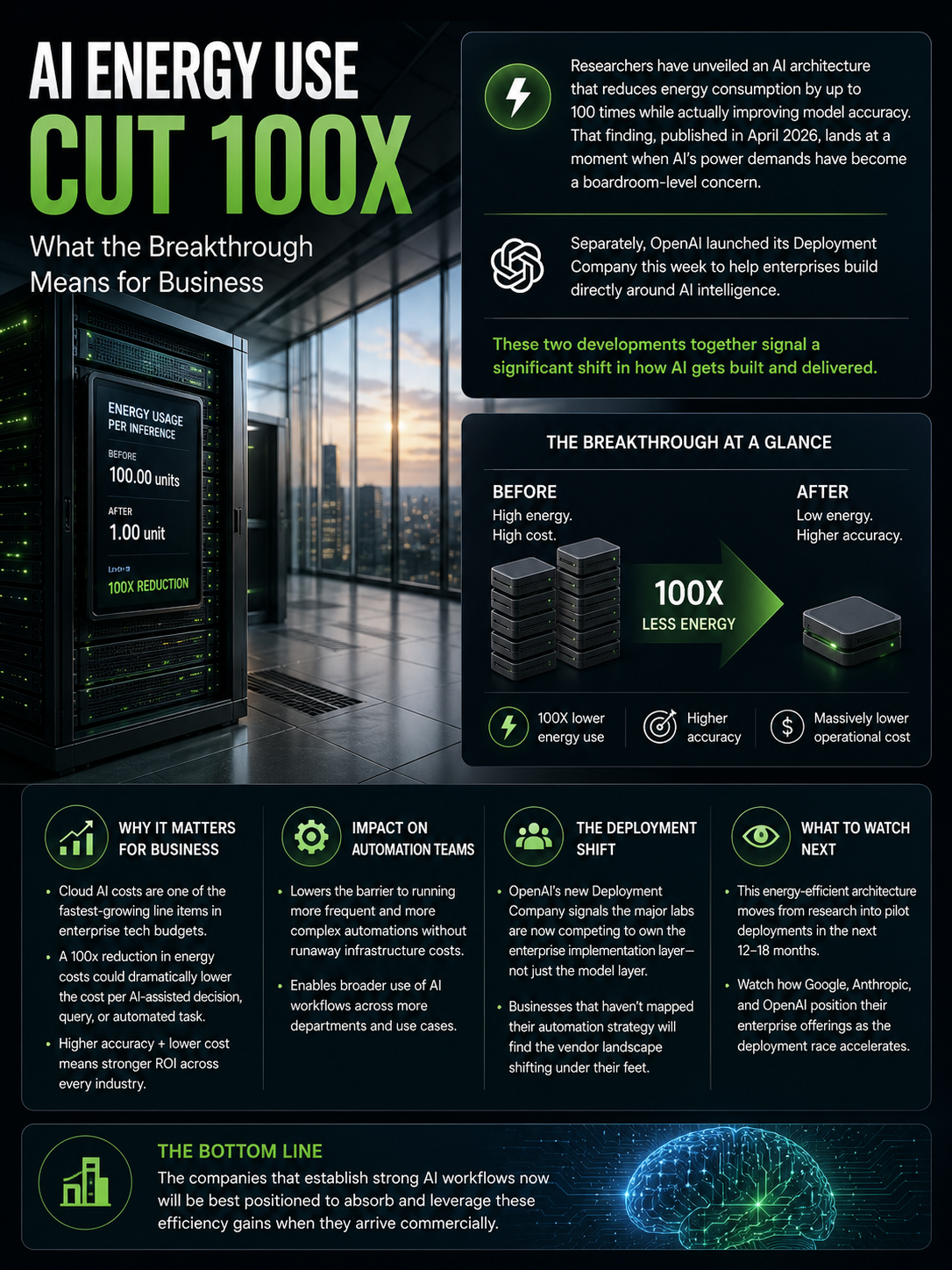
Researchers have unveiled an AI architecture that reduces energy consumption by up to 100 times while actually improving model accuracy. That finding, published in April 2026, lands at a moment when AI's power demands have become a boardroom-level concern. Separately, OpenAI launched its Deployment Company this week to help enterprises build directly around AI intelligence. These two developments together signal a significant shift in how AI gets built and delivered.
The energy breakthrough works by rethinking how AI models process and store information at a fundamental level, not just by compressing existing systems. Current large models consume enormous compute resources both during training and inference — inference being the moment the model answers your query. A 100x reduction in that cost changes the economics of running AI at scale. Higher accuracy alongside lower cost means businesses no longer have to trade performance for efficiency.
Any company currently running or planning to run AI at scale should pay close attention. Cloud AI costs are one of the fastest-growing line items in enterprise tech budgets right now. If this architecture reaches production deployment, it could meaningfully compress the cost per AI-assisted decision, query, or automated task. That changes ROI calculations across industries from financial services to logistics to healthcare.
For teams building AI-powered workflows and automation pipelines, this matters on two levels. First, it lowers the barrier to running more frequent, more complex automations without runaway infrastructure costs. Second, OpenAI's new Deployment Company signals that the major labs are now actively competing to own the enterprise implementation layer — not just the model layer. Businesses that have not yet mapped their automation strategy will find the vendor landscape shifting under their feet.
Watch for this energy-efficient architecture to move from research into pilot deployments within the next 12 to 18 months. Simultaneously, track how Google, Anthropic, and OpenAI position their enterprise offerings as the deployment race accelerates. The companies that establish strong AI workflows now will be better positioned to absorb and leverage these efficiency gains when they arrive commercially.