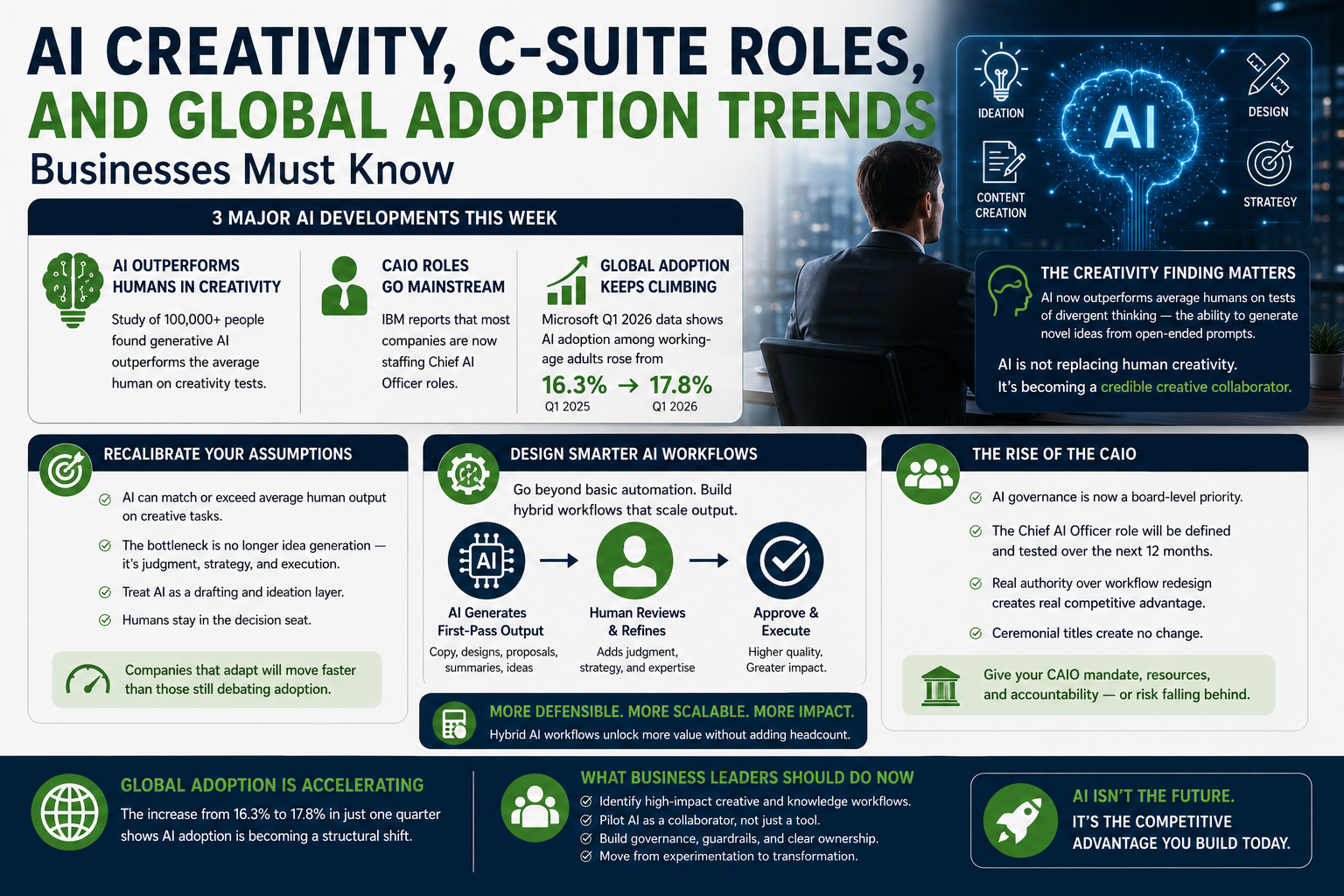
Three major AI developments landed this week that deserve attention from any business leader making decisions about technology. A study of over 100,000 people found that generative AI now outperforms the average human on certain creativity tests. Separately, IBM reported that most companies are now staffing Chief AI Officer roles. And Microsoft's Q1 2026 data shows global AI adoption among working-age adults climbed from 16.3% to 17.8% — a steady, structural shift, not a spike.
The creativity finding matters because creativity was one of the last domains widely considered safe from automation. These tests measure divergent thinking — the ability to generate novel ideas from open-ended prompts. AI clearing that bar does not mean human creativity is obsolete. It means AI is now a credible creative collaborator, not just a productivity tool for repetitive tasks.
Business leaders in marketing, product development, content, and R&D should recalibrate their assumptions. If AI can match or exceed average human output on creative tasks, the bottleneck in those functions is no longer idea generation — it is judgment, strategy, and execution. Companies that treat AI as a drafting and ideation layer while keeping humans in the decision seat will move faster than those still debating whether to adopt it at all.
This shift directly changes how AI automation workflows should be designed. Pipelines that only automate data processing or scheduling are leaving significant value on the table. The more defensible build right now is a hybrid workflow where AI handles first-pass creative output — copy, designs, proposals, summaries — and human experts review, refine, and approve. That architecture scales output without scaling headcount.
The rise of the Chief AI Officer role signals that AI governance is becoming a board-level concern, not just an IT conversation. Watch how that role gets defined over the next 12 months. Companies that give their CAIO real authority over workflow redesign will pull ahead. Those that make it a ceremonial title will stall.