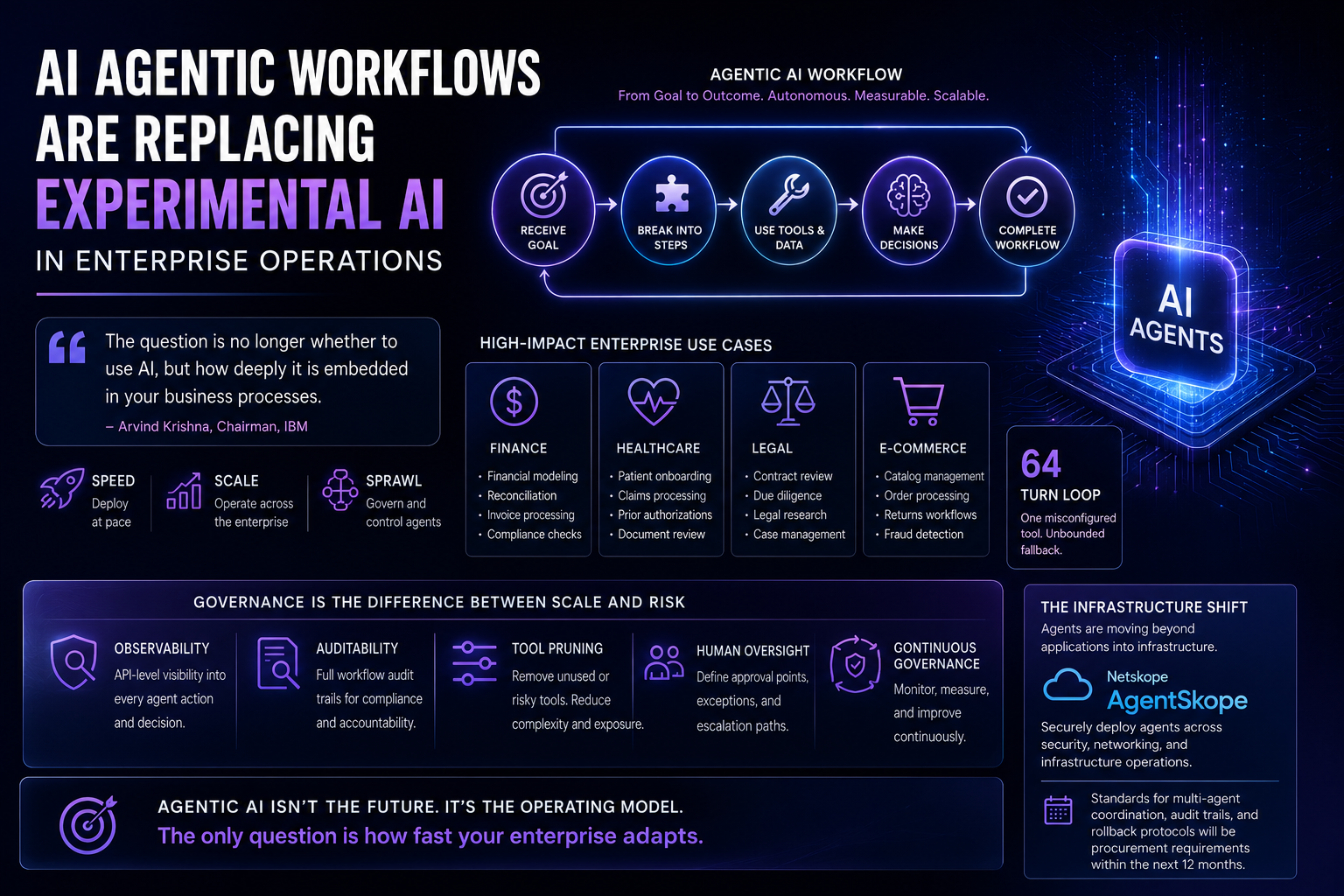
IBM's Think 2026 conference made one message clear: the era of AI experimentation is over. Leaders from Disney, BNP Paribas, New York Life, and EY gathered to discuss building agentic enterprises at speed and scale. IBM Chairman Arvind Krishna framed the shift bluntly: the question is no longer whether to use AI, but how deeply it is embedded in your business processes. That distinction separates companies running pilots from companies running operations.
Agentic AI differs from standard AI tools in one critical way: it acts, not just responds. An agent can receive a goal, break it into steps, call external tools, make decisions mid-task, and complete multi-stage workflows without human intervention at each step. Anthropic's Claude-based agents are now targeting financial services specifically, handling financial modeling, data operations, and customer due diligence end-to-end. AWS describes this generation of agentic solutions as tools that help teams ship code, resolve customer issues, hire faster, and plan supply chains — not features bolted onto existing software, but autonomous process owners.
Finance, healthcare, legal, and e-commerce operations have the most immediate exposure to this shift. Firms like Kanerika are already deploying regulation-focused autonomous agents in those verticals. For any business running repetitive, rules-based workflows — invoice processing, compliance checks, customer onboarding, catalog management — the cost of not automating is rising fast. The competitive gap between agentic adopters and non-adopters is widening quarter by quarter.
The practical challenge is not building an agent. It is governance. IBM's Think 2026 framing — speed, scale, and sprawl — names the real operational risk: agents multiplying across teams without oversight frameworks. GitHub's work on agentic workflow efficiency shows exactly how ungoverned agents fail, citing a case where a single misconfigured tool triggered a 64-turn fallback loop. Effective agentic deployment requires API-level observability, workflow auditing, and deliberate tool pruning from day one. Organizations that treat agentic AI as an IT project rather than a process redesign effort will generate technical debt faster than they generate efficiency.
The next signal to watch is how security infrastructure adapts. Netskope's launch of AgentSkope — a platform for deploying agents across security and networking tasks — signals that agentic workflows are moving into infrastructure layers, not just business applications. When agents start managing network operations autonomously, governance stakes rise significantly. Standards for multi-agent coordination, audit trails, and rollback protocols will likely become procurement requirements within the next 12 months.
Sources
- Managing agentic AI's speed, scale and sprawl: Insights from Think 2026 | IBM
- Understanding AI Agents: The Technology Reshaping Business Automation in 2026 - Blockonomi
- Agentic AI Solutions and Development Tools - AWS
- Top 15 AI Agent Development Companies In The USA [2026] | DevСom
- Improving token efficiency in GitHub Agentic Workflows - The GitHub Blog
- Agentic AI News — Launches, Models & Research | Agentic.ai