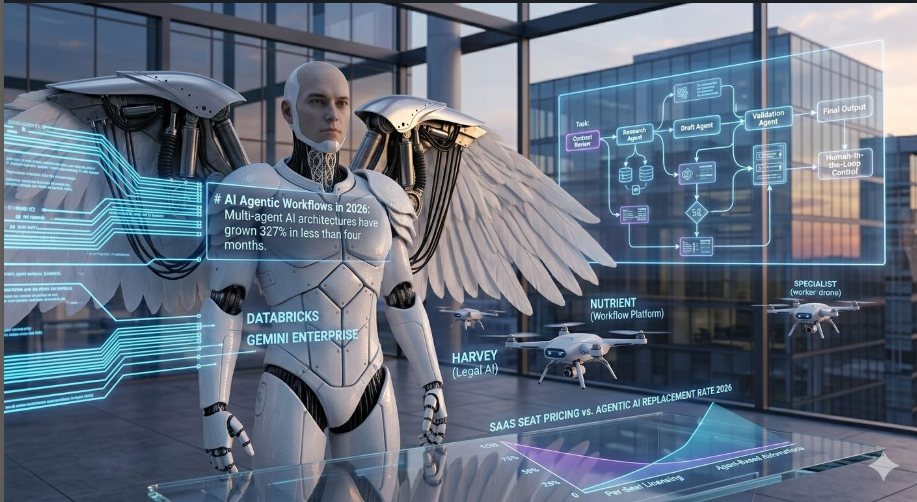
Major enterprise platforms are moving fast. Box just launched Box Automate for orchestrating agentic workflows at scale. Microsoft is combining Copilot with Azure-hosted multi-agent systems to automate complex tasks across Microsoft 365. AWS is pushing the same direction, positioning its agentic AI solutions as the shift from experimentation to actual deployment.
Agentic AI is different from basic automation. A standard workflow follows a fixed script — trigger, action, output. An AI agent reasons through a goal, selects tools, makes decisions, and adapts mid-task without human input. Multi-agent systems go further: specialized agents hand off work to each other, similar to how a team of humans would divide a project. That's what platforms like Microsoft Azure and AWS Bedrock are now building natively into their infrastructure.
Any business running high-volume, decision-heavy processes should pay close attention. Finance, healthcare, legal, and supply chain operations are already seeing purpose-built agents deployed at the workflow level — not just as assistants, but as autonomous operators. Gartner predicts that by end of 2026, over 2,000 legal claims will cite "death by AI" due to insufficient risk guardrails. The business case for agents is real, but so is the liability exposure from deploying them without governance.
The practical opportunity sits at the intersection of workflow design and agent orchestration. Most companies don't fail at AI because the technology isn't ready — they fail because their processes weren't mapped, their data isn't clean, and no one defined decision boundaries for the agent to operate within. Building agentic workflows that actually hold up means doing the process engineering work first, then layering in the AI. That sequence matters more than the tool selection.
Snowflake and other data platforms are now embedding agents directly into analytics and development pipelines. No-code AI platforms are making deployment faster for non-technical teams. Watch for the next wave of consolidation: companies that built point-solution automations will start replacing them with unified agentic layers. The businesses that designed clean, modular workflows in 2024 and 2025 will have a significant deployment advantage in the next 12 months.
Sources
- Strategic Predictions for 2026: How AI's Underestimated Influence Is Reshaping Business
- Why Businesses Are Replacing Entire Workflows with AI Agents in 2026
- Box Launches Box Automate to Orchestrate Agentic Workflows
- Microsoft deepens AI workflow push with Copilot and Azure agents
- Agentic AI Solutions and Development Tools - AWS
- AI Workflow Automation Trends in 2026: 10 Trends Shaping the Future of Work
- Does Snowflake's New AI Workflow Upgrades Reshape The Bull Case For Snowflake