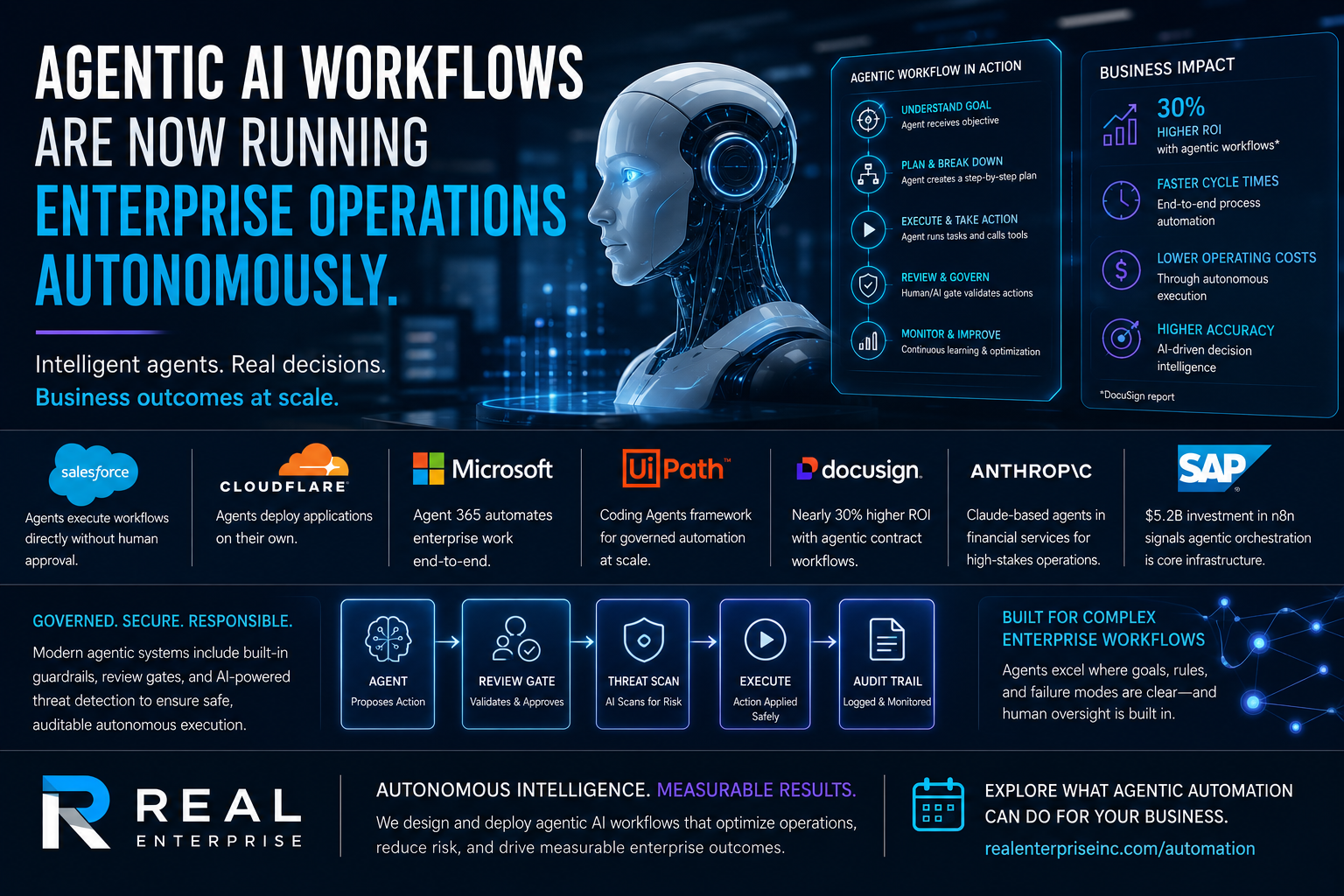
Three major platforms activated autonomous agent capabilities this week. Salesforce opened its system so agents execute workflows directly without human approval. Cloudflare lets agents deploy applications on their own. Microsoft launched Agent 365 to automate enterprise work end-to-end. At the same time, UiPath shipped its Coding Agents framework on May 12, giving enterprises a governed way to build, test, and deploy automations at scale.
Agentic AI differs from standard automation in one critical way: it reasons and plans, not just executes. These agents can take a goal, break it into steps, call external tools, and act — without waiting for a human at each decision point. The GitHub Agentic Workflows framework illustrates the architecture well: agents propose actions, a separate gated job reviews them, and an AI-powered threat detection layer scans outputs before anything is applied. That layered design is what separates responsible agentic deployment from reckless one.
Any business running complex, multi-step back-office workflows should be paying close attention. Docusign's new agentic contract workflows for legal teams come with hard data: organizations using agentic workflows with an end-to-end platform are seeing nearly 30% higher ROI than those that don't. Anthropic has moved Claude-based agents directly into financial services, targeting financial modeling, data operations, and customer due diligence — high-stakes use cases where speed and accuracy both matter. SAP's $5.2B investment in n8n signals that enterprise infrastructure vendors are now treating agentic orchestration as core infrastructure, not a feature.
The practical build question is no longer whether to use agents — it's how to govern them. Enterprises that wire agents directly into production systems without permission boundaries, audit logs, and rollback controls are taking on real operational risk. The right approach starts with mapping which workflow segments have clear inputs, outputs, and failure modes. Agents perform best where the rules are definable and the stakes of a bad action are recoverable. That scoping work is where most implementations succeed or fail before a single line of automation is written.
Watch how Microsoft's Agent 365 adoption curve develops over the next two quarters. The platform's reach into existing enterprise tooling means it could become the default orchestration layer for mid-market and enterprise companies that already live in the Microsoft ecosystem. The more interesting signal will be whether governance tooling — audit trails, permission scoping, anomaly detection — matures fast enough to keep pace with how quickly these agents are being deployed.
Sources
- 6 Best AI Agents for Business Automation in 2026
- Understanding AI Agents: The Technology Reshaping Business Automation in 2026
- Unlocking Enterprise Transformation at Scale With UiPath for Coding Agents
- Docusign Announces Agentic Contract Workflows for In-House Legal Teams
- SAP backs n8n at $5.2B valuation to automate complex, data-heavy enterprise workflows with AI
- Home | GitHub Agentic Workflows
- Daily AI Agent News - Last 7 Days