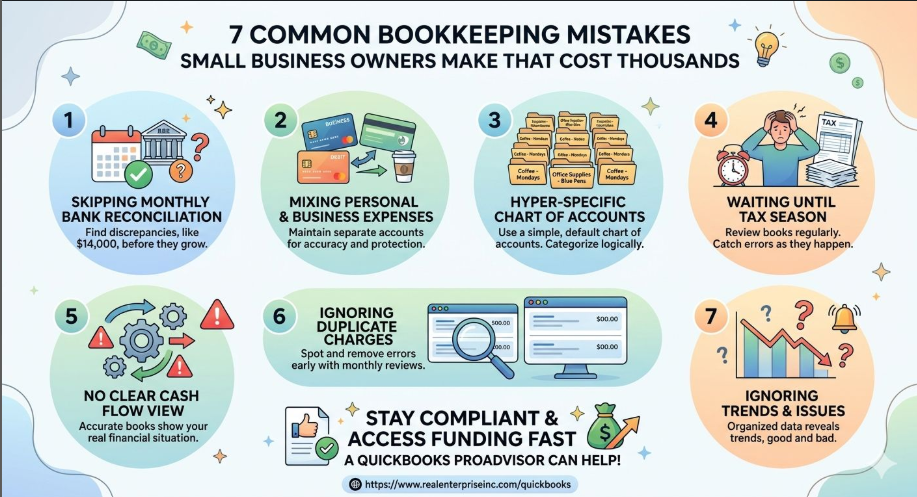
A landscaper in Mobile finds out in April that his books are off by $14,000 — not because he spent it wrong, but because he never reconciled his bank account once in 2025. His lender needs accurate financials for a equipment loan. His accountant needs clean records to file. Neither can do their job. That one habit — skipping monthly reconciliation — turned a routine loan application into a financial emergency.
Most small business owners don't have a spending problem. They have a recordkeeping problem. The most common errors aren't dramatic — they're quiet. Mixing personal and business expenses on the same card. Creating 40 hyper-specific chart of accounts categories when five would work better. Waiting until tax season to look at the books at all. These habits feel harmless in the moment, but they compound fast. By Q2, your P&L is telling a story that doesn't match reality, and you're making decisions based on bad data.
Start with separation — a dedicated business checking account and business credit card, used exclusively for business. This is non-negotiable for LLCs and corporations, where commingling funds can actually pierce your liability protection. In QuickBooks Online, you connect those accounts directly through the Banking tab and let the transaction feed do the heavy lifting. Set aside 30 minutes every month to review and categorize what came in. That one habit eliminates about 60% of the chaos most business owners bring to their accountant in January.
Next, simplify your chart of accounts. If you have a category called "Coffee for Client Meetings (Mondays)," that's a red flag. The IRS doesn't require that level of granularity — it actually makes your books harder to read and easier to misfile. In QuickBooks Online, use the default chart of accounts as your baseline and only add a sub-account when there's a real reporting reason. "Meals and Entertainment" covers client coffee. Keep it clean, keep it consistent, and your financial reports will finally be useful at a glance.
Clean books don't just make tax season easier — they change what's possible throughout the year. When your accounts are reconciled monthly, you can actually see your cash flow. You catch duplicate charges. You spot trends before they become problems. You also protect yourself: if the IRS ever questions a deduction, organized records with clear categorization are your first line of defense. Businesses with accurate books also qualify for financing faster, because lenders trust what they can verify.
If any of this feels familiar — the mixed accounts, the skipped reconciliations, the shoebox of receipts — you're not alone, and it's fixable. A QuickBooks ProAdvisor can clean up months of tangled books faster than you'd expect and set up a system you can actually maintain. If you want a fresh set of eyes on your setup, you can book a free consultation at https://www.realenterpriseinc.com/quickbooks and walk away with a clear picture of where you stand.
Sources
- Bookkeeping for Small Business: Your Questions Answered (Minus the Boring Stuff)
- Common Bookkeeping Mistakes That Make Tax Filing Harder For Mobile, AL Business Owners
- 9 Common DIY Bookkeeping Mistakes That Cost Small Business Owners Thousands
- Common Small Business Accounting Mistakes to Avoid
- Bookkeeping for Small Business Owners: What You Need to Know in 2026
- Best Practices in Accounting for Small Businesses